Showing posts with label Ancient Delhi - Pre 1300 AD. Show all posts
Friday, January 17, 2014
Tuesday, July 3, 2012
Qutb Group of Monuments Part Two
Tuesday, July 03, 2012
Alai Darwaza, Alai Minar, Ancient Delhi - Pre 1300 AD, Delhi (Pre 1600 A.D.), Delhi-iteful Tuesdays, Mehrauli, Monuments of 1300 - 1700 A.D., Qutb Minar, Quwwat ul Islam Mosque, The No Nonsense Travel Advice, UNESCO World Heritage Site
0 comments
(Continued from Qutb Group of Monuments Part One.......)
Period of Khalji Sultan Ala ud din
The Khalji dynasty succeeded the Mamluk dynasty in 1290 A.D. Sultan Ala ud din Khalji (1296 - 1316), during his reign, tripled the size of the Quwwat ul Islam Mosque to accommodate the city's growing Muslim population. Ala ud din Khalji also decided to build another minaret, the Alai Minar, meant to be taller and larger than the existing Qutb Minar. Ala ud din Khalji also added a madarsa to the southwestern end of the complex and the historically significant Alai Darwaza (1311 A.D.) on its southern end.
The Alai Darwaza is a richly decorated gateway, renowned for its use of a bold polychromatic scheme. Three other gates were also added to this mosque extension, two at the eastern wall and one at the northern wall.
It is the main gateway from southern side of the Quwwat-ul-Islam Mosque. Second Khalji Sultan of Delhi, Ala ud din Khalji in 1311 AD, also added a court to the pillared to the eastern side. The domed gateway is decorated with red sandstone and inlaid white marble decorations, inscriptions in Naskh script, latticed stone screens and showcases the remarkable craftsmanship of the Turkic artisans who worked on it.
Sandstone carvings at the base of the Alai Darwaza
At the back of the complex, southwest of the mosque, stands an L-shaped construction, consisting of Ala ud din Khalji's Tomb dating 1316 AD, and a madarsa, an Islamic seminary built by him. The central room of the building, which has his tomb, has now lost its dome, though many rooms of the seminary or college are intact, and since been restored.
Nearby stands the Alai Minar, an ambitious tower of victory. Ala ud din Khalji started constructing this minaret to rival the Qutb Minar, after his armies (led by Malik Kafur) triumphed in the landmark Deccan (Central and South India) campaign (through which he got possession of the world famous Kohinoor Diamond). He died when only its first storey was built and its construction was abandoned thereafter.
Period of Tughluq Sultan Feroze Shah
The minar was first struck by lightning in 1368 AD, which knocked off its top storey. The necessary repairs were done by Sultan Feroze Shah Tughluq (1351-1388). Sultan Feroze Shah Tughluq added the top two floors which were faced with white marble and sandstone enhancing the distinctive variegated look of the minar, as seen in lower three storeys.
Sultan Feroze Shah also added a cupola (chhatri) at the top of the minar. This cupola (chhatri) fell down in an earthquake in 1802 and was damaged. These architectural additions were done by Sultan Tughluq in his own style which is why the structure displays a marked variation in architectural styles from the Mamluk dynasty to that of the Tughluq dynasty.
Period of Lodi Sultan Sikandar
Inscriptions at the Qutb Minar indicate further repairs by Sultan Sikandar Lodi (of the Lodi Dynasty) in 1503, when it was struck by lightning once again.
Another monument hailing to the Lodi dynasty's period was the Tomb of Imam Muhammad Ali, or Imam Zamin. It stands on a raised courtyard, next to the Alai Darwaza. As per an inscription of the eastern entrance to the tomb, Imam Zamin was a saint from Central Asia (Turkestan), who settled in India around 1500 A.D. , during the reign of Sikandar Lodi. He built his tomb during his lifetime, and was buried here after his death in 1539 AD. The sandstone structure has a dome on an octagonal base, while its interior is finished in polished white plaster, and contains fine, perforated jaalis, or screens common in Lodi period architecture.
Period of British Colonial Rule
In the year 1802 the Qutb Minar was damaged by an earthquake and the cupola (chhatri) on the top (erected by Sultan Feroze Shah Tughlaq) was thrown down. It was repaired by Major R. Smith of the Royal Engineers in 1223 and replaced the previous cupola (chhatri) with a Bengali-style chhatri. It was removed by Governor General, Lord Hardinge in 1848, as it looked out of place, and now stands in the outer lawns of the complex, popularly known as Smith's Folly.
.......
Period of Khalji Sultan Ala ud din
The Khalji dynasty succeeded the Mamluk dynasty in 1290 A.D. Sultan Ala ud din Khalji (1296 - 1316), during his reign, tripled the size of the Quwwat ul Islam Mosque to accommodate the city's growing Muslim population. Ala ud din Khalji also decided to build another minaret, the Alai Minar, meant to be taller and larger than the existing Qutb Minar. Ala ud din Khalji also added a madarsa to the southwestern end of the complex and the historically significant Alai Darwaza (1311 A.D.) on its southern end.
Alai Darwaza, with the tomb of Imam Zamin to the right. Alai Darwaza was the first building in India to employ Islamic architectural principles in its construction and ornamentation.
It is the main gateway from southern side of the Quwwat-ul-Islam Mosque. Second Khalji Sultan of Delhi, Ala ud din Khalji in 1311 AD, also added a court to the pillared to the eastern side. The domed gateway is decorated with red sandstone and inlaid white marble decorations, inscriptions in Naskh script, latticed stone screens and showcases the remarkable craftsmanship of the Turkic artisans who worked on it.
Sandstone carvings at the base of the Alai Darwaza
Observe the minarets carved of red sandstone and marble and their flowery base. Also observe the intricate carving on red sandstone which reach till the ceiling.
This is the first building in India to employ Islamic architecture principles in its construction and ornamentation. The Mamluk (Slave) dynasty did not employ true Islamic architecture styles and used false domes and false arches, this makes the Alai Darwaza, the earliest example of first true arches and true domes in India.
Another door of Alai Darwaza facing the Qutb Minar. Observe the unique red sandstone carvings all around the door frame.
It is considered to be one of the most important buildings built in the Delhi sultanate period. With its pointed arches and spearhead of fringes, identified as lotus buds, it adds grace to the Quwwat-ul-Islam mosque to which it served as an entrance.
The tomb of Ala ud din Khalji. The grave and the ceiling of the mausoleum is gone.
The madarsa next to the tomb of Ala ud din Khalji. This was the first example in India of a tomb standing alongside a madarsa.
This is the unfinished base of the mammoth tower Alai Minar, begun by Ala ud din Khalji intended to give competition to Qutb Minar.
Nearby stands the Alai Minar, an ambitious tower of victory. Ala ud din Khalji started constructing this minaret to rival the Qutb Minar, after his armies (led by Malik Kafur) triumphed in the landmark Deccan (Central and South India) campaign (through which he got possession of the world famous Kohinoor Diamond). He died when only its first storey was built and its construction was abandoned thereafter.
Period of Tughluq Sultan Feroze Shah
The minar was first struck by lightning in 1368 AD, which knocked off its top storey. The necessary repairs were done by Sultan Feroze Shah Tughluq (1351-1388). Sultan Feroze Shah Tughluq added the top two floors which were faced with white marble and sandstone enhancing the distinctive variegated look of the minar, as seen in lower three storeys.
The top two floors looks distinctly different in design than the lower floors. The top two floors were built in Tughluq style by the Emperor Feroze Shah Tughluq who also conducted repairs over the monument.
Sultan Feroze Shah also added a cupola (chhatri) at the top of the minar. This cupola (chhatri) fell down in an earthquake in 1802 and was damaged. These architectural additions were done by Sultan Tughluq in his own style which is why the structure displays a marked variation in architectural styles from the Mamluk dynasty to that of the Tughluq dynasty.
Period of Lodi Sultan Sikandar
Inscriptions at the Qutb Minar indicate further repairs by Sultan Sikandar Lodi (of the Lodi Dynasty) in 1503, when it was struck by lightning once again.
Tomb of Imam Zamin
Another monument hailing to the Lodi dynasty's period was the Tomb of Imam Muhammad Ali, or Imam Zamin. It stands on a raised courtyard, next to the Alai Darwaza. As per an inscription of the eastern entrance to the tomb, Imam Zamin was a saint from Central Asia (Turkestan), who settled in India around 1500 A.D. , during the reign of Sikandar Lodi. He built his tomb during his lifetime, and was buried here after his death in 1539 AD. The sandstone structure has a dome on an octagonal base, while its interior is finished in polished white plaster, and contains fine, perforated jaalis, or screens common in Lodi period architecture.
Period of British Colonial Rule
Sanderson's Sundial
Major Smith's Cupola (Smith's Folly)
In the year 1802 the Qutb Minar was damaged by an earthquake and the cupola (chhatri) on the top (erected by Sultan Feroze Shah Tughlaq) was thrown down. It was repaired by Major R. Smith of the Royal Engineers in 1223 and replaced the previous cupola (chhatri) with a Bengali-style chhatri. It was removed by Governor General, Lord Hardinge in 1848, as it looked out of place, and now stands in the outer lawns of the complex, popularly known as Smith's Folly.
The No-Nonsense Travel Advice
| |
Name of the Monument
|
Qutb Complex
|
Constructed By
|
Emperors
Qutb ud din Aibak, Iltutmish and Others
|
Period of Construction
|
12th, 13th and 16th centuries. Repair work carried out during 14th, 16th and 19th centuries.
|
Location
|
Mehrauli,
New Delhi
|
How to Reach
|
(By
Metro) Get down at Qutub Minar Metro Station (on the Yellow Line) and walk
the short distance OR take an Auto Rickshaw from your Starting Point OR take
a Hop-On-Hop-Off sightseeing bus which is run by Delhi Tourism. Fare is Rs
300 for Adults and Rs 150 for children. Checkout Delhi Tourism
website
for details.
|
Entrance Fee
|
.
Citizens of India and visitors from Bangladesh, Nepal, Bhutan, Sri Lanka,
Pakistan, Maldives, Afghanistan, Thailand and Myanmar - Rs. 10 per head
.
Visitors from other countries -
Indian
Rs. 250/- per head
.
(Free entry to children up to 15 years)
|
Suggested Reading
| |
.......
Tuesday, June 19, 2012
Qutb Group of Monuments Part One
Tuesday, June 19, 2012
Ancient Delhi - Pre 1300 AD, Delhi (Pre 1600 A.D.), Delhi-iteful Tuesdays, Destination Delhi (Series), Mehrauli, Qila Rai Pithora, Qutb Minar, Quwwat ul Islam Mosque, The No Nonsense Travel Advice, UNESCO World Heritage Site
0 comments
The Qutb Group of Monuments in Mehrauli, New Delhi, is a group of monuments constructed by various kings who ruled Delhi over a period of time. The Qutb Group of Monuments includes the Qutb Minar, Alai Darwaza, Iron Pillar, Alai Minar, Ruins of demolished Hindu and Jain Temples, Sultan Iltutmish's Tomb, Sultan Ala ud din Khalji's Tomb, Madarsa (Islamic Seminary) constructed by Ala ud din Khalji, Arch Ruin of Quwwat ul Islam Mosque, Smith's Folly, Sanderson's Sundial, Tomb of Imam Zamin. There are, of course, other monuments of equal historical and archaeological importance which surround the Qutb Group of Monuments and form a part of the Mehrauli Archaeological Park.
The Qutb Group of Monuments were built (as per timeline) by the Hindu Rajas (till 1192), the Mamluks Sultans (Qutb ud din Aibak 1206-10 and Shams ud din Iltutmish 1211-36), the Khalji Sultan Ala ud din (1296-1316), and the Tughluq Sultan Feroze Shah (1353-88). Each of the rulers mentioned above have left a deep imprint on the history of India as well as on this Complex.
Period of Hindu Rajas
The first rulers who constructed monuments (temples) in this area were the Tomars and Prithvi Raj Chauhan II, who got constructed 27 Hindu and Jain (Jainism) temples. The ruler Anangpal Tomar also got shifted, the iron pillar which was located originally at Udayagiri, in the 10th century, to its present location.
Most of those temples were demolished by Qutb ud din Aibak who reused the materials for the construction of the Quwwat ul Islam Mosque and the Qutb Minar (as per a Persian inscription on the inner eastern gateway). Although some portions of the temples outside the mosque were left untouched, and they remain standing there till this date. Historical records compiled by Muslim historian Maulana Hakim Saiyyid Abdul Hai confirms the destruction of the temples by Qutb-ud-din Aibak.
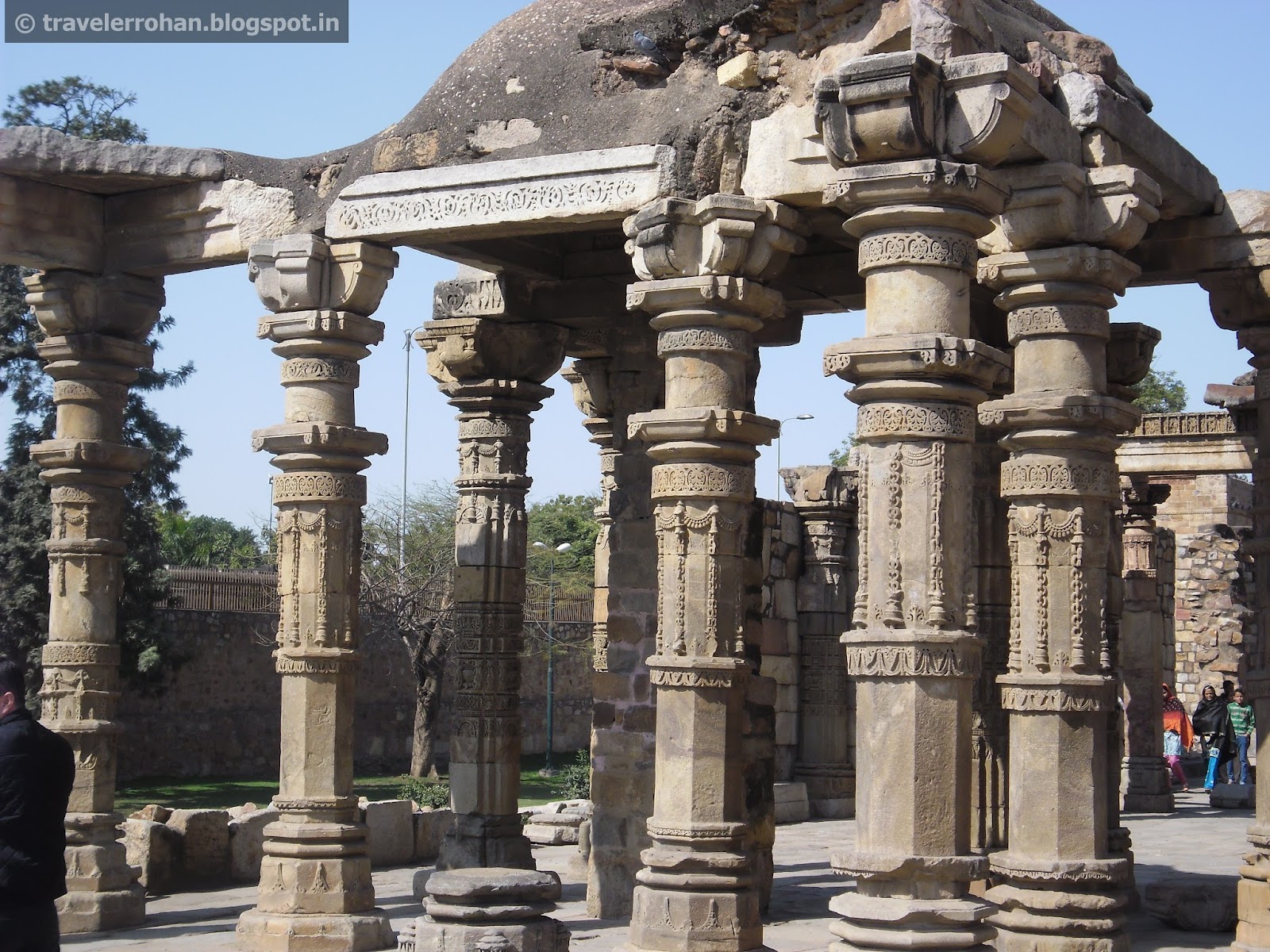
Some shafts of the temple columns, decorated with carved human figures covered in bracelets and cable and link chains terminating in bells or tassel rosettes, were left alone. On some of the overhead slabs, representations of Vishnu and Buddha along with lotus motifs are still visible.
One of the biggest wonders in the Qutb Group of Monuments, apart from the Qutb Minar, is the (over 1600 years old) Iron Pillar. This Iron Pillar is 7.21 m (23 ft) high and 14,354pounds (6511 kgs) in weight. It is located right in front of the arch ruin of Quwwat ul Islam mosque and is notable for the composition of the metals used in its construction.
The pillar, is said to have been fashioned at the time of Chandragupta Vikramaditya (375–413) of the Gupta Empire. The pillar was originally erected in front of a Lord Vishnu Temple complex at Udayagiri around 402 AD, and later shifted by Raja Anangpal Tomar in 10th Century AD from Udayagiri to its present location. Raja Anangpal built a Vishnu Temple here and wanted this pillar to be a part of that temple.
The pillar has attracted the attention of archaeologists and metallurgists and has been called "a testament to the skill of ancient Indian blacksmiths" because of its high resistance to corrosion, due to both the Delhi environment providing alternate wetting and drying conditions, and iron with high phosphorus content conferring protection by the formation of an even layer of crystalline iron hydrogen phosphate.
Period of Mamluk Sultans (Qutb ud din Aibak and Iltutmish)
Qutb ud din Aibak was a general in the army and a slave of Mohammad Ghori. So when Mohammad Ghori (after his invasion of India) went back to Afghanistan he left him (after making him Naib us Sultan) in charge of his territories in India. Iltutmish too was a slave (later a son in law) of Qutb ud din Aibak. So this is where the term 'Mamluk' (or a soldier of Slave origin) gets attached to these rulers and their dynasty.
They were the first Islamic rulers to govern India. They did so effectively and efficiently in matters of defence and administration. These rulers also constructed quite a few monuments amongst which the most iconic is the Qutb Minar.
The other monument of reputation built by them is the Quwwat-ul-Islam mosque (Might of Islam) (also known as the Qutb Mosque or the Great Mosque of Delhi). It was the first mosque built in Delhi after the Islamic conquest of India and the oldest surviving example of Ghurid architecture in Indian subcontinent.
The construction of this Jami Masjid (Friday Mosque), started in the year 1193 AD. The Qutb Minar was built simultaneously with the mosque but is a stand alone structure, built as the 'Minar of Jami Masjid', for the muezzin to perform Azan (call for prayer) and also as a 'Qutb - an Axis or Pole of Islam'.
The mosque is built on a raised and paved courtyard, measuring 141 ft (43 m) by 105 ft (32 m), surrounded by pillared cloisters added by Iltutmish between 1210 and 1220 AD. The stone screen between prayer hall and the courtyard, standing 16 mt at its highest was added in 1196 AD, the corbelled arches had Arabic inscriptions and motifs.
By the time of Iltutmish, the Mamluk empire had stabilized enough that the Sultan could replace most of his conscripted Hindu masons with Muslims which explained why the arches added under Iltutmish are stylistically more Islamic than the ones erected under Qutb ud din's rule, also because the material used wasn't from demolished temples.
The mosque is in ruins today but indigenous corbelled arches, floral motifs, and geometric patterns can be seen among the Islamic architectural structures.
Another structure of importance in the Qutb Complex built during the Mamluk Period was the Tomb of Emperor Iltutmish, (1211-1236 AD).
The central chamber of the tomb is 9 sq. mt and has squinches, suggesting the existence of a dome, which has since collapsed. The main cenotaph, in white marble, is placed on a raised platform in the centre of the chamber. The facade is known for its ornate carving, both at the entrance and the interior walls. The interior west wall has a prayer niche (Mihrab) decorated with marble, and a rich amalgamation of Hindu motives into Islamic architecture, such as bell-and-chain, tassel, lotus, diamond emblems.
(To be continued.......)
.......
(Starting from the previous week's edition of Delhi-iteful Tuesdays you would be presented a fresh and acutely informative series christened Destination Delhi. This series would cover the beautiful and historical city of Delhi in detail and present you every 'landmark' worth visiting. So, Discover and Enjoy..)
The Qutb Group of Monuments were built (as per timeline) by the Hindu Rajas (till 1192), the Mamluks Sultans (Qutb ud din Aibak 1206-10 and Shams ud din Iltutmish 1211-36), the Khalji Sultan Ala ud din (1296-1316), and the Tughluq Sultan Feroze Shah (1353-88). Each of the rulers mentioned above have left a deep imprint on the history of India as well as on this Complex.
Period of Hindu Rajas
The first rulers who constructed monuments (temples) in this area were the Tomars and Prithvi Raj Chauhan II, who got constructed 27 Hindu and Jain (Jainism) temples. The ruler Anangpal Tomar also got shifted, the iron pillar which was located originally at Udayagiri, in the 10th century, to its present location.
Some of the remaining pillars of the destroyed Hindu and Jain temples. Observe the carvings of bells, chains e.t.c. over them.
One of the more beautifully carved and still standing pillar.
Most of those temples were demolished by Qutb ud din Aibak who reused the materials for the construction of the Quwwat ul Islam Mosque and the Qutb Minar (as per a Persian inscription on the inner eastern gateway). Although some portions of the temples outside the mosque were left untouched, and they remain standing there till this date. Historical records compiled by Muslim historian Maulana Hakim Saiyyid Abdul Hai confirms the destruction of the temples by Qutb-ud-din Aibak.
Observe the carving of a bell with chains hanging from a mythical creatures mouth
One of the biggest wonders in the Qutb Group of Monuments, apart from the Qutb Minar, is the (over 1600 years old) Iron Pillar. This Iron Pillar is 7.21 m (23 ft) high and 14,354pounds (6511 kgs) in weight. It is located right in front of the arch ruin of Quwwat ul Islam mosque and is notable for the composition of the metals used in its construction.
The Iron Pillar
Arch Ruin of the Quwwat ul Islam Mosque and the Iron Pillar standing next to each other
The pillar, is said to have been fashioned at the time of Chandragupta Vikramaditya (375–413) of the Gupta Empire. The pillar was originally erected in front of a Lord Vishnu Temple complex at Udayagiri around 402 AD, and later shifted by Raja Anangpal Tomar in 10th Century AD from Udayagiri to its present location. Raja Anangpal built a Vishnu Temple here and wanted this pillar to be a part of that temple.
Inscriptions over the Iron Pillar
Period of Mamluk Sultans (Qutb ud din Aibak and Iltutmish)
Qutb ud din Aibak was a general in the army and a slave of Mohammad Ghori. So when Mohammad Ghori (after his invasion of India) went back to Afghanistan he left him (after making him Naib us Sultan) in charge of his territories in India. Iltutmish too was a slave (later a son in law) of Qutb ud din Aibak. So this is where the term 'Mamluk' (or a soldier of Slave origin) gets attached to these rulers and their dynasty.
They were the first Islamic rulers to govern India. They did so effectively and efficiently in matters of defence and administration. These rulers also constructed quite a few monuments amongst which the most iconic is the Qutb Minar.
Qutb Minar
The other monument of reputation built by them is the Quwwat-ul-Islam mosque (Might of Islam) (also known as the Qutb Mosque or the Great Mosque of Delhi). It was the first mosque built in Delhi after the Islamic conquest of India and the oldest surviving example of Ghurid architecture in Indian subcontinent.
Entrance to the Quwwat ul Islam Mosque
The construction of this Jami Masjid (Friday Mosque), started in the year 1193 AD. The Qutb Minar was built simultaneously with the mosque but is a stand alone structure, built as the 'Minar of Jami Masjid', for the muezzin to perform Azan (call for prayer) and also as a 'Qutb - an Axis or Pole of Islam'.
Side View of the mosque
The mosque is built on a raised and paved courtyard, measuring 141 ft (43 m) by 105 ft (32 m), surrounded by pillared cloisters added by Iltutmish between 1210 and 1220 AD. The stone screen between prayer hall and the courtyard, standing 16 mt at its highest was added in 1196 AD, the corbelled arches had Arabic inscriptions and motifs.
By the time of Iltutmish, the Mamluk empire had stabilized enough that the Sultan could replace most of his conscripted Hindu masons with Muslims which explained why the arches added under Iltutmish are stylistically more Islamic than the ones erected under Qutb ud din's rule, also because the material used wasn't from demolished temples.
Inscriptions above the entrance of Quwwat ul Islam Mosque
The beautiful interiors of the dome of the mosque (the materials used here were taken from the demolished Hindu temples)
The mosque is in ruins today but indigenous corbelled arches, floral motifs, and geometric patterns can be seen among the Islamic architectural structures.
Another structure of importance in the Qutb Complex built during the Mamluk Period was the Tomb of Emperor Iltutmish, (1211-1236 AD).
The Tomb of Iltutmish. The prayer niche (Mihrab) is visible behind the grave.
The central chamber of the tomb is 9 sq. mt and has squinches, suggesting the existence of a dome, which has since collapsed. The main cenotaph, in white marble, is placed on a raised platform in the centre of the chamber. The facade is known for its ornate carving, both at the entrance and the interior walls. The interior west wall has a prayer niche (Mihrab) decorated with marble, and a rich amalgamation of Hindu motives into Islamic architecture, such as bell-and-chain, tassel, lotus, diamond emblems.
The No-Nonsense Travel Advice
| |
Name of the Monument
|
Qutb Complex
|
Constructed By
|
Emperors
Qutb ud din Aibak, Iltutmish and Others
|
Period of Construction
|
12th, 13th and 16th centuries. Repair works carried out during 14th, 16th and 19th centuries.
|
Location
|
Mehrauli,
New Delhi
|
How to Reach
|
(By
Metro) Get down at Qutub Minar Metro Station (on the Yellow Line) and walk
the short distance OR take an Auto Rickshaw from your Starting Point OR take
a Hop-On-Hop-Off sightseeing bus which is run by Delhi Tourism. Fare is Rs
300 for Adults and Rs 150 for children. Checkout Delhi Tourism
website
for details.
|
Entrance Fee
|
.
Citizens of India and visitors from Bangladesh, Nepal, Bhutan, Sri Lanka,
Pakistan, Maldives, Afghanistan, Thailand and Myanmar - Rs. 10 per head
.
Visitors from other countries -
Indian
Rs. 250/- per head
.
(Free entry to children up to 15 years)
|
Suggested Reading
| |
(To be continued.......)
.......
(Starting from the previous week's edition of Delhi-iteful Tuesdays you would be presented a fresh and acutely informative series christened Destination Delhi. This series would cover the beautiful and historical city of Delhi in detail and present you every 'landmark' worth visiting. So, Discover and Enjoy..)
Tuesday, June 5, 2012
Qutb Minar
Tuesday, June 05, 2012
Ancient Delhi - Pre 1300 AD, Delhi, Delhi Tourism, Delhi-iteful Tuesdays, Destination Delhi (Series), Qutb Minar, UNESCO World Heritage Site, world heritage site
2 comments
Qutb Minar (pronounced Qoot-ub Minar), a UNESCO World Heritage Site is located in Delhi, India. The Qutb Minar, constructed with red sandstone, marble, lime mortar and rubble masonry, is the tallest brick minaret in the world, with a height of 72.5 metres (237.8 ft). It contains 379 stairs to reach the top, and the diameter of the base is 14.32 m while it is about 2.75 m on the top. It is surrounded by several other ancient and medieval structures and ruins, collectively known as the Qutb complex.
Their are many reasons cited for the construction of the Minar. The most commonly accepted reasons are that In order to celebrate the advent of Muslim dominance in Delhi (and India), the first ruler of the Delhi sultanate, Qutb-ud-din Aibak, inspired by the Minaret of Jam in Afghanistan and wishing to surpass it, commenced construction of the Qutb Minar in 1199 A.D. Qutb ud din Aibak also wanted it for the use of the mu'azzin (crier) to give calls for prayer (in the city of Qila Rai Pithora). The minar was completed by his successor Shamsu'd-Din Iltutmish.
The Entrance into the Minar
A snapshot of the Kufic inscriptions on the first floor of the Minar. This floor was constructed while the first Slave (Mamluk) King Qutbuddin Aibak was alive and majority of these inscriptions praise Mohammed Ghori (Qutbuddin's master)
The Minar, made with numerous superimposed flanged and cylindrical shafts in the interior, and fluted columns on the exterior, which have a 40 cm thick veneer of red and buff coloured sandstone; all surrounded by bands of intricate carving in Kufic style of Islamic calligraphy, give the Minar the appearance of 'bundled reeds' from a distance. Also marking a progression in era, is the appearance of inscriptions in a bold and cursive Thuluth script of calligraphy on the Qutb Minar, distinguished by strokes that thicken on the top, as compared to Kufic in earlier part of the construction.
View of the honey comb like designs under the balcony of the First Floor of the Minar. The Minar represents an excellent example of Indo-Islamic architecture
The Qutb Minar and the Quwwat ul Islam Mosque are built on the ruins of 27 (demolished) Hindu and Jain temples, which were built by the Tomars and the Chauhans, who were amongst the last Hindu rulers of Delhi.
Many historians believe that the Qutb Minar was named after the first Slave King Qutb-ud-din Aibak, but others contend that it was named in honour of the Sufi Saint Qutb-ud-din Bakhtiyar Kaki, from the Middle East who came to live in India and was greatly venerated by Sultan Iltutmish.
Observe the distinct top two floors (covered with marble) of the Minar which were constructed by Emperor Feroze Shah Tughlaq
As the Qutb Minar was a tower of immense height quite a few times it got struck by lightning and so, had to be repaired time and again. According to the inscriptions on its surface the Minar was repaired restored by Emperor Feroze Shah Tughlaq (AD 1351-88), Emperor Sikandar Lodi (AD 1489-1517) and Major R.Smith in 1829.
The Iron Pillar and the Qutb Minar
The nearby Iron Pillar is one of the world's foremost metallurgical curiosities, standing in the famous Qutb complex. Tradition assigns the erection of the Pillar to Anang Pal Tomar, whose name it bears, with the date 1052 C.E. According to the traditional belief, anyone who can encircle the entire column with their arms, with their back towards the pillar, can have their wish granted. Because of the corrosive qualities of sweat the government has built a fence around it for safety. The quality of Iron used in the pillar is an excellence of technology. The smoothness of the pillar surface makes it rust proof. The amalgamation of different metals with Iron produces such high quality of smoothness.
The minar as seen from the ruins of the Quwwat ul Islam Mosque. Observe the tilt of the minaret towards the right.
The Qutb Minar has a tilt of 25 inches to the southwest. This is considered
to be "within safe limits", but experts have stated that the monument
needs regular monitoring in case rainwater seepage further weakens the
foundation.
The No-Nonsense Travel Advice
|
|
Name of the Monument
|
Qutb
Minar
|
Constructed By
|
Emperors
Qutb ud din Aibak and Iltutmish
|
Year of Construction
|
1199
A.D.
|
Location
|
Mehrauli,
New Delhi
|
How to Reach
|
(By
Metro) Get down at Qutub Minar Metro Station (on the Yellow Line) and walk
the short distance OR take an Auto Rickshaw from your Starting Point OR take
a Hop-On-Hop-Off sightseeing bus which is run by Delhi Tourism. Fare is Rs
300 for Adults and Rs 150 for children. Checkout Delhi Tourism
website
for details.
|
Entrance Fee
|
.
Citizens of India and visitors from Bangladesh, Nepal, Bhutan, Sri Lanka,
Pakistan, Maldives, Afghanistan, Thailand and Myanmar - Rs. 10 per head
.
Visitors from other countries -
Indian
Rs. 250/- per head
.
(Free entry to children up to 15 years)
|
Suggested Reading
|
|
.......
(From this bi-weekly edition of Delhi-iteful Tuesdays
you would be presented a fresh and acutely informative series christened as Destination Delhi.
This series would cover the beautiful and historical city of Delhi in
detail and present you every 'landmark' worth visiting. So, Discover and
Enjoy..)