The 28th Delhi Book Fair 2024

A posts on the crowds, books and my experiences of The Delhi Book Fair 2024.

Remembering Professor Sunil Kumar

He was one of the greatest historians who worked on the history of medieval delhi, which served as capital of the Delhi Sultanate (1192-1526 CE) for 300 years.

Temple of the Emerald Buddha - Amazing Thailand

This series is based over my reflections upon visiting Thailand.

The Immortal Kumbh Mela - Mahakumbha of 2013

Believed to be the largest congregation of mankind in the world, read my series of posts to know how it feels like to be amongst a magnitude of people

Shahjahanabad (Const 1648 CE)- The Legacy of Delhi Series (Vol 8)

'Shahjahanabad' is the eighth post in a series of 9 articles on the former capital cities which were built in the historical region of Delhi. Read on to know more..

Follow

uencounter.me
Showing posts sorted by relevance for query thailand. Sort by date Show all posts

Saturday, August 16, 2014

Tranquil Thailand #1 - The Begining


In the days of old when travellers like Ibn Battuta, Hiuen Tsang, Christopher Columbus amongst others went on their journeys the expenses of their journeys were covered by either their rulers (of the country they lived in) or by seeking sponsors or paying from their own pockets as travelling (full-time) was, is and will remain an expensive affair.. So, when I got an invitation from the Thailand Authority of Tourism to visit Thailand and see from my own eyes how the things (the atmosphere in Thailand) are, it didn't take me much time to say 'Yes' !!

Pictures of some of the greatest travellers the world has ever seen ! One of the biggest similarities between them, apart from their penchant for travel, is that they all had to struggle to arrange for funds to go on their epic journeys !!

Being a popular travel destination, travellers from all parts of the world make a beeline to go to Thailand so therefre there are a lot of general perceptions vis a vis Thailand which float around and I wanted to know whether they really stood true. I have talked to many people (friends/relatives/acquaintances/travellers) and discussed with them about Thailand as a tourist destination. For the Europeans its the beautiful beaches and the calm locales of Phuket and Koh Samui, for the Indians it's the party destinations of Pattaya and the shopping experiences of Krung Thep (Bangkok) and elsewhere, everyone has their own reason to head to Thailand. But of recent the number of people heading to Thailand has come down as the general perception regarding Thailand, which is prevalent in the world is that as there has been a military coup (and as military coup's in other parts of the world are all about blood and gore and everything nasty), it is not safe to go there.

A 'Welcome' signboard at the gate of the grand palace

So, when Thailand Authority of Tourism called, I was more than keen to go myself and observe myself as to what is it in Thailand which inspires tourists to make it their preferred travel destination year after year, and whether the rumours (that all was not safe in Thailand, and tanks would be rolling on the streets as a military coup had happened) held true or not. I knew, from discussions with travelers from other parts of the world, that much of the 'unsafe Thailand talk was Not True' but nonetheless when i had an oppurtunity to see from my own eyes the ground realities i would surely accept it !

The people of Thailand are a calm and simple lot. More prone to smiling than anything else !

The TAT in association with the Thai Airways and our hosts the Ramada Plaza Bangkok Menam Riverside and the Amari Hua Hin organised a trip for us media personnel (i have been a travel blogger for 4 years but i am still coming to terms with the fact that us bloggers are considered as media around the world, unlike in India where majority of people are yet to wake up to the power of Bloggers) to see for ourselves the beauty of Thailand, the rich culture of Thailand, to see for ourselves that nothing had changed (and if change happened it was only for the better) and to see for ourselves the character and resilient nature of the Thai people as after the coup (which succeeded a long period of political turmoil) took place they put their entire house in order within 2 months. This trip had a purpose, a mission !

The flag of Thailand is a common feature across the country, one can see it fluttering atop buildings, market places, boats e.t.c.

(to be continued..)
.......

I am naming my series of posts over Thailand - 'Tranquil Thailand' as that is how i found the people, the atmosphere and even the gulf (named after Thailand) to be.. Completely Tranquil !! To quote our friend Saravuth, ' In Thailand calmness is the norm, anger/rowdiness is frowned upon'

Friday, October 10, 2014

Picture of the Week #104 - Kuha Karuhas Pavilion in Phraya Nakhon Cave


Picture © Rohan Anirudh Singh
Located in the Khao Sam Roi Yot National Park (near Pranburi, can also be reached from Hua Hin) in the Prachuap Khiri Khan Province, this cave has a mystical touch to it. A cave which has formations of both stalactites and stalagmites has a sense of peace which can't be matched anywhere in Thailand. The fact that the Kings of Thailand used to come here regularly (and erected the golden pavilion) stands as a testament to that fact.
The Phraya Nakhon Cave is undoubtedly on of the 'best' places to visit in Thailand !

.......

This post marks 2 years of the series which has captured the lengths and breadths of India, various landmarks in Australia, Italy, Denmark e.t.c. (Thanks to Traveler Richa!) and Thailand. 
A lot of effort has gone into presenting the sights and the information (about it) to you in the best and concise-est possible manner ! Hope that you have loved the journey uptill now and are raring to go ahead because we are :)

Friday, September 12, 2014

Picture of the Week #100 - Phra Thinang Chakri Maha Prasat, Bangkok (1882 AD)


Phra Thinang Chakri means 'Seat of the Chakri Dynasty' (the monarchs of Thailand). This is the Throne Hall of the Rulers of Thailand.
Picture © Rohan Anirudh Singh

Friday, September 19, 2014

Picture of the Week #101 - Thanon Sukhumvit (Road), Bangkok


Also known as Thailand Route 3 the Sukhumvit Road is one of the major commercial hubs in Bangkok and thus in Thailand. It starts from Bangkok itself and runs uptill Cambodia while running parallel to the coast.
Picture © Rohan Anirudh Singh

Friday, September 5, 2014

Picture of the Week #99 - Beach on Gulf of Thailand, Pranburi


An upcoming beachtown, Pranburi is also is also the closest to Phraya Nakhon Cave. Boats going towards the cave leave from here. This pic was shot doing low tide, so the gulf had receding some 100mts away.

Friday, December 26, 2014

Picture of the Week #115 - Baavan Deori, Kumbhalgarh (1464 AD)


Picture © Rohan A Singh

The year of 2014 has been a roller coaster ride for me, especially the days of July and August. From experiencing the high of visiting Thailand (my first foreign trip thanks to TAT) to being forced to deal with a severe emotional loss as a result of my beloved granny departing the physical realm for her final journey, within a fortnight of me returning. In a state of bereavement i had to lead a group of travelers (as a part of Roots Travel Group) to Kumbhalgarh, the fortress of Mewar rulers.

This particular picture is of Baavan Deori (Baavan means 52) a temple located at a distance from the main tourist sections of the expansive Kumbhalgarh and at a location where mobile signals aren't available. It had started to drizzle and we were contemplating whether to head back when we saw the shikhars of this temple (at a distance) and we decided to dash through the rain and checkout this isolated temple which had a charm of its own.

Travel helped me, in a way, to come to terms with my loss and my visit to Kumbhalgarh will always be special in my heart !

Friday, December 19, 2014

Picture of the Week #114 - Phra Sri Rattana Chedi (Golden Stupa) (1855 AD)


Picture © Rohan A Singh
Located in the Grand Palace Complex in Krung Thep (Bangkok) this holy stupa was covered with golden mosaic tiles, on the orders of King Rama V of Thailand.

Tuesday, December 20, 2011

Glimpses of International Trade Fair 2011

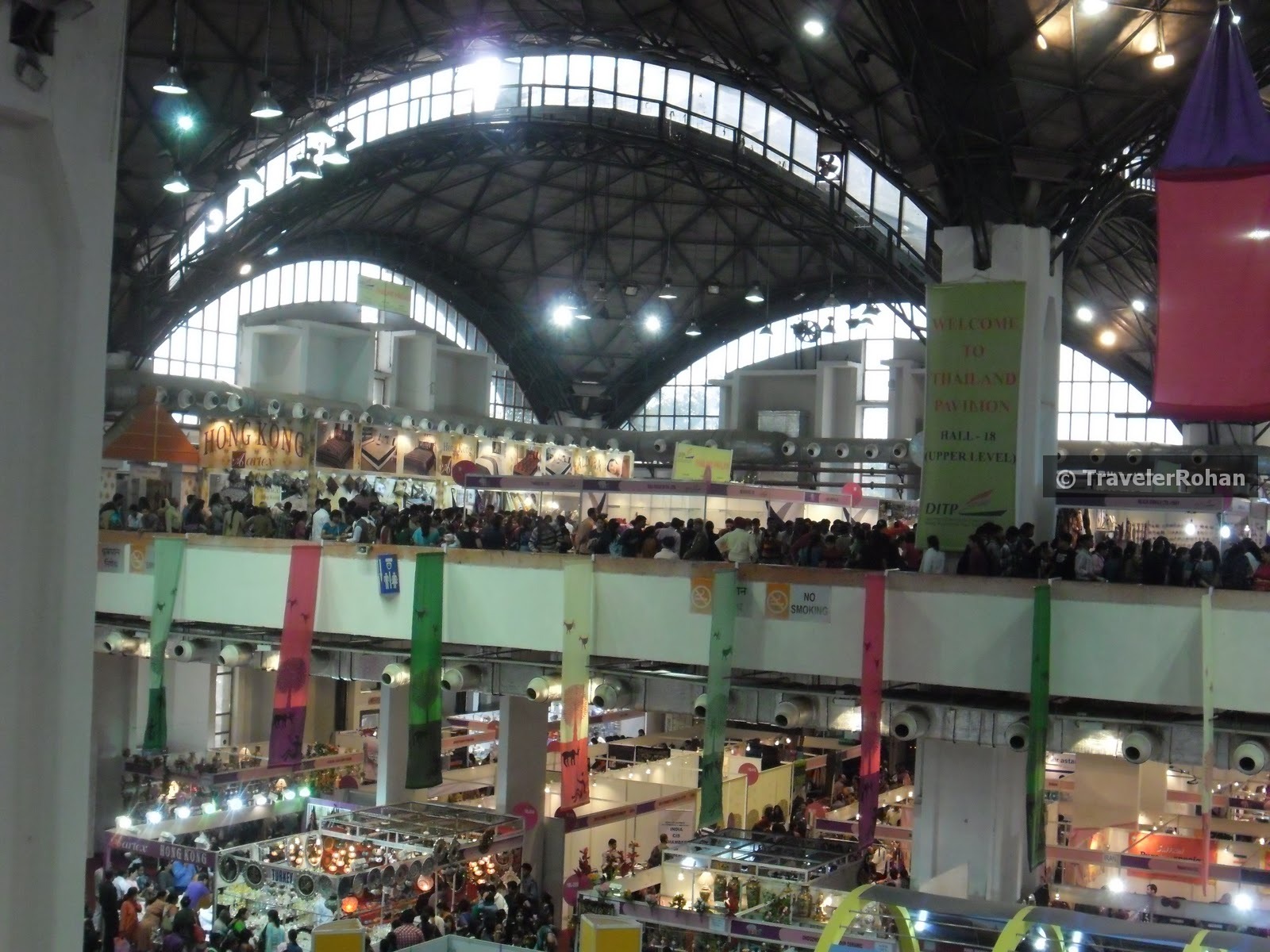
The annual India International Trade Fair 2011 held in New Delhi was a great event to visit in the month of November. Many countries, all of the 28 Indian states (provinces) and hundreds of government and private organisations participated in it, making it a gala event. Millions of people thronged to it and the fair was so large that given the large crowds it would have taken atleast 2-3 days to cover it entirely.

Amongst the many pavilions depicted the life and culture of the various states of India it was the pavilions of Kerala State and Odisha State which were one of the best. Amongst the international participants it was the pavilion of Thailand which was offering the best deals and it was the pavilion of Pakistan which won most of the hearts. Here are the glimpses of the fair -

Terracotta figurine of Goddess Saraswati (Goddess of Wisdom) displayed at the pavilion of India's Bihar Province

A giant painting depicting tribal art adorned the hall hosting international pavilions

Afghanistan Pavilion. Trade fair attracts participation from various countries. Trade Fair 2011 saw participation of countries like Canada, China, Pakistan e.t.c.

Pavilions of Turkey, China and Hong Kong

At the far end of the hall is the Thai pavilion. Visitors thronged to the Thai pavilion as they had some great stuff to sell at competitive prices.

Wooden figure of Lord Krishna drawing Arjuna's chariot in the epic battle of Mahabharata

Figure of Gautama Buddha in front of Bihar Province's(State) pavilion. The Mahabodhi Tree under which Buddha attained enlightenment is located in Bihar Province(State)

Pavilion of Bihar Province(State)

Traditional musicians playing enchanting music through their Bamboo made musical instruments

Observe the crown of the instrument which has a plume of peacock feathers

Wooden figurines displaying various dance forms

Wooden statue of a mother stork over it's nest


Wooden Handicraft with the head of a female

Ceramic Potteries - Urns and a Vase

Lord Balaji of Tirupati in Andhra Province(State) (Andhra Pradesh Pavilion)

A craftsman giving finishing touches to the statue of Lord Ganesha

A tribal figurehead made completely with bamboo adorned the entrance of Assam Province pavilion

A statue of a tribal musician made with bamboo sticks

The next three pictures below are of the statues of religious deities whose temples are found in Odisha Province. These deities were depicted in the Odisha Pavilion -

Lord Jagannath. The annual Ratha (Chariot) Yatra in honor of Lord Jagannath at his temple in Puri attracts millions of pilgrims every year 

Goddess Subhadra (Sister of Lord Jagannath)

Lord Balabhadra (Brother of Lord Jagannath)


View of the Pakistan pavilion
Despite the projected bitterness between the political and army class of both countries, the people of both nations are keen for peace to prevail. The willingness for friendship was indicated by people thronging in great numbers to the Pakistani pavilion giving the traders good business.

The following pictures are of the Pavilion of Kerala Province which consistently wins the award of best decorated pavilion in the Trade Fair-

Pavilion of Kerala Province


The statue depicts a Kathakali dancer. Kathakali is the traditional dance style originating in Kerala.

The idol of Lord Ayyappa atop an elephant


Elephants are an integral part of life in Kerala and so is sculpting

.......

You can now join our Facebook Page for beforehand information and exclusive pictures.

Friday, August 29, 2014

Friday, January 16, 2015

Picture of the Week #118 - Wat Arun (Const 17th Cent CE)


Picture © Rohan A Singh
Wat Arun used to house the famous Emerald Buddha statue until it was shifted to its present location, at the Wat Phra Kaew in the Grand Palace Complex in Bangkok, Thailand

Friday, November 21, 2014

Picture of the Week #110 - View of the Gulf of Thailand


The Phraya Nakhon Cave is located at the Khao Sam Roi Yot Park National Park
© Rohan A Singh

Tuesday, April 24, 2012

Dinpanah (Shergarh) (1538 A.D.) - The Legacy of Delhi Vol 7

(In this edition of Delhi-iteful Tuesdays I am bringing to you the seventh edition of this historical series The Legacy of Delhi.) 

Introduction - 
                               The location on which the city of Dinpanah was established by 'Humayun' the second emperor of the Mughal Dynasty is said to have been consistently inhabited since 1000 B.C.  So when Emperor Humayun decided to built his capital city here it was not much of a surprise despite the fact that, the locations of Dinpanah was completely different as compared to the locations of most of the capital cities of Delhi built earlier.
                              A look through the Archaeological Museum located inside the fort will reveal you how rich this place was in terms of artifacts which were discovered by archaeologists during excavations conducted by them in 1955 and again from 1969 to 1973.  
                               
 A view of the Humayun gate (or the South Gate) from inside the fort

Physical Map of Delhi depicting the location of Dinpanah (Shergarh)

History -  
              
                 The second Mughal Emperor Humayun in the year 1533 A.D. founded the city of Dinpanah (Refuge of the Pious). This he did after holding consultations with various learned men and various scholars.  The city was also located in very close proximity to the shrine of Delhi`s most revered saint, Nizam ud Din Auliya. The belief of local Hindu populace that the mythological city of Indraprastha existed on that very spot also could have contributed to the decision to build the city where it was made.
                  Today only the inner citadel of this city which is popularly known as Purana Qila stands. There were a number of villages in and around the citadel like the villages of Indrapat(located in the fort itself), Raisina and Malcha (located where Lutyens Delhi stands today) which were uprooted by the Britishers during the construction of New Delhi in 1913 A.D.           
                 When emperor Humayun lost the throne of Dinpanah (Delhi) and Sher Shah Suri took over, he brought down the portions of the city constructed by Humayun and rebuilt it himself, and re-named the city as Shergarh.
 
View of the Fort ramparts from the moat (now called the Old Fort Lake)


Architecture -
                               Its high walls of rubble masonry with a slight batter, 4 m. thick and as much as 21 m. high in places, have a battlemented parapet above the row of arrow-slits, behind which all along the circumference are built a series of chambers in a two-aisle depth. There are massive bastions on the four corners, in addition to five bastions in the western wall, and three gates, all double-storeyed, one on each side except on the east. The gates have a veneer of red and buff sandstones, with an ornamental use of white and black marble and coloured tiles. 
                              The three main gates of the fort were Bara Darwaza, (Big Gate) facing west, which is still in use today, The South Gate, popularly known as the Humayun Gate (either because it was constructed by Humayun, or because Humayun's Tomb is visible from there) and the Talaqi Gate, often known as the "forbidden gate".
                              Despite the immense exterior, few of interior structures have survived except the Qila i Kuhna Mosque and the Sher Mandal, both of which were said to be constructed Sher Shah Suri.


Decline -
                 After Emperor Akbar took over the Mughal Empire he shifted his capital 195 kms south to Agra and from there to Fatehpur Sikri. The spotlight moved away from the Old Fort gradually althught it continued to function as a military garrison for quite a while.


The No-Nonsense Travel Advice
Name of the City
Dinpanah (or Shergarh) (Today it is commonly called as Old Fort or Purana Qila)
Constructed By
Sher Shah Suri and Humayun
Year of Completion
1538 A.D.
Location
On Mathura Road (near Delhi Zoo), New Delhi
How to Reach
. The Old Fort is approximately 2 kms/1.24 miles from Pragati Maidan Metro Rail Station (on the Blue Line).  You could either walk the short distance or take an auto from there.
. The correct Auto Fare is only Rs 20 (as per the government issued fare chart) so there is a good chance of either the auto driver fleecing you or not wanting to go at all.
Entrance Fee
. Citizens of India and visitors from Bangladesh, Nepal, Bhutan, Sri Lanka, Pakistan, Maldives, Afghanistan, Thailand and Myanmar - Rs. 5 per head
. Visitors from other countries -
US $ 2 or Indian Rs. 100/- per head
. (Free entry to children up to 15 years)
. There is an archaeological museum inside the fort as well.  The ticket price is Rs 2 for Indians.

**

You can now join our Facebook Page (by clicking on the link) for more travel information and exclusive pictures.

Tuesday, June 5, 2012

Qutb Minar


Qutb Minar (pronounced Qoot-ub Minar), a UNESCO World Heritage Site is located in Delhi, India. The Qutb Minar, constructed with red sandstone, marble, lime mortar and rubble masonry, is the tallest brick minaret in the world, with a height of 72.5 metres (237.8 ft). It contains 379 stairs to reach the top, and the diameter of the base is 14.32 m while it is about 2.75 m on the top. It is surrounded by several other ancient and medieval structures and ruins, collectively known as the Qutb complex.


Their are many reasons cited for the construction of the Minar. The most commonly accepted  reasons are that In order to celebrate the advent of Muslim dominance in Delhi (and India), the first ruler of the Delhi sultanate, Qutb-ud-din Aibak, inspired by the Minaret of Jam in Afghanistan and wishing to surpass it,  commenced construction of the Qutb Minar in 1199 A.D. Qutb ud din Aibak also wanted it for the use of the mu'azzin (crier) to give calls for prayer (in the city of Qila Rai Pithora). The minar was completed by his successor Shamsu'd-Din Iltutmish.

The Entrance into the Minar


A snapshot of the Kufic inscriptions on the first floor of the Minar.  This floor was constructed while the first Slave (Mamluk) King Qutbuddin Aibak was alive and majority of these inscriptions praise Mohammed Ghori (Qutbuddin's master)

The Minar, made with numerous superimposed flanged and cylindrical shafts in the interior, and fluted columns on the exterior, which have a 40 cm thick veneer of red and buff coloured sandstone; all surrounded by bands of intricate carving in Kufic style of Islamic calligraphy, give the Minar the appearance of 'bundled reeds' from a distance. Also marking a progression in era, is the appearance of inscriptions in a bold and cursive Thuluth script of calligraphy on the Qutb Minar, distinguished by strokes that thicken on the top, as compared to Kufic in earlier part of the construction.

View of the honey comb like designs under the balcony of the First Floor of the Minar. The Minar represents an excellent example of Indo-Islamic architecture

The Qutb Minar and the Quwwat ul Islam Mosque are built on the ruins of 27 (demolished) Hindu and Jain temples, which were built by the Tomars and the Chauhans, who were amongst the last Hindu rulers of Delhi.


Many historians believe that the Qutb Minar was named after the first Slave King Qutb-ud-din Aibak, but others contend that it was named in honour of the Sufi Saint Qutb-ud-din Bakhtiyar Kaki, from the Middle East who came to live in India and was greatly venerated by Sultan Iltutmish.

Observe the distinct top two floors (covered with marble) of the Minar which were constructed by Emperor Feroze Shah Tughlaq

As the Qutb Minar was a tower of immense height quite a few times it got struck by lightning and so, had to be repaired time and again. According to the inscriptions on its surface the Minar was repaired restored by Emperor Feroze Shah Tughlaq (AD 1351-88), Emperor Sikandar Lodi (AD 1489-1517) and Major R.Smith in 1829.

The Iron Pillar and the Qutb Minar

The nearby Iron Pillar is one of the world's foremost metallurgical curiosities, standing in the famous Qutb complex. Tradition assigns the erection of the Pillar to Anang Pal Tomar, whose name it bears, with the date 1052 C.E. According to the traditional belief, anyone who can encircle the entire column with their arms, with their back towards the pillar, can have their wish granted. Because of the corrosive qualities of sweat the government has built a fence around it for safety. The quality of Iron used in the pillar is an excellence of technology. The smoothness of the pillar surface makes it rust proof. The amalgamation of different metals with Iron produces such high quality of smoothness.


The minar as seen from the ruins of the Quwwat ul Islam Mosque. Observe the tilt of the minaret towards the right.

The Qutb Minar has a tilt of 25 inches to the southwest. This is considered to be "within safe limits", but experts have stated that the monument needs regular monitoring in case rainwater seepage further weakens the foundation.


The No-Nonsense Travel Advice
Name of the Monument
Qutb Minar
Constructed By
Emperors Qutb ud din Aibak and Iltutmish
Year of Construction
1199 A.D.
Location
Mehrauli, New Delhi
How to Reach
(By Metro) Get down at Qutub Minar Metro Station (on the Yellow Line) and walk the short distance OR take an Auto Rickshaw from your Starting Point OR take a Hop-On-Hop-Off sightseeing bus which is run by Delhi Tourism. Fare is Rs 300 for Adults and Rs 150 for children. Checkout Delhi Tourism website for details.
Entrance Fee
. Citizens of India and visitors from Bangladesh, Nepal, Bhutan, Sri Lanka, Pakistan, Maldives, Afghanistan, Thailand and Myanmar - Rs. 10 per head
. Visitors from other countries -
Indian Rs. 250/- per head
. (Free entry to children up to 15 years)
Suggested Reading
.......
(From this bi-weekly edition of Delhi-iteful Tuesdays you would be presented a fresh and acutely informative series christened as Destination Delhi. This series would cover the beautiful and historical city of Delhi in detail and present you every 'landmark' worth visiting. So, Discover and Enjoy..)