The 28th Delhi Book Fair 2024

A posts on the crowds, books and my experiences of The Delhi Book Fair 2024.

Remembering Professor Sunil Kumar

He was one of the greatest historians who worked on the history of medieval delhi, which served as capital of the Delhi Sultanate (1192-1526 CE) for 300 years.

Temple of the Emerald Buddha - Amazing Thailand

This series is based over my reflections upon visiting Thailand.

The Immortal Kumbh Mela - Mahakumbha of 2013

Believed to be the largest congregation of mankind in the world, read my series of posts to know how it feels like to be amongst a magnitude of people

Shahjahanabad (Const 1648 CE)- The Legacy of Delhi Series (Vol 8)

'Shahjahanabad' is the eighth post in a series of 9 articles on the former capital cities which were built in the historical region of Delhi. Read on to know more..

Follow

uencounter.me

Friday, February 22, 2013

Tuesday, February 19, 2013

The Immortal Kumbh Mela # 2 - On the Road to Sangam

(This is the second part of my travelogue of my series over the Purna Kumbh Mela - 2013, 'The Immortal Kumbh Mela'. This post is in continuation of the first post. The posts in this series will be in a continuous form.)

My first day in Prayag (better known as Allahabad) was not at all what I had expected it to be.. There is nothing much to write about it as well apart from the fact that I lost an entire day to a stomach bug so that left me with Sunday, the day of the Shahi Snan (Royal Bath) on the occasion of Mauni Amavasya.

On Sunday I started early.. As I, did not wish to walk 9 kms to the Sangam (the confluence of the Rivers Ganges, Yamuna and the mythological Saraswati).. I decided to take the train to it. That was quite an effort. I enquired from the porters (or coolie's) at the Allahabad Station whether Shiv Ganga Express (a decent train which had just arrived) would stop at Daraganj (the station closest to the Mela ground).. On getting a positive response I went for the platform only to see a huge swarm of people trying to squeeze into the same train as I was. I made for the coach with the least amount of crowd on its door and pushed myself into it. More people came and pushed me further in. The train started moving but came to a halt at the very next station (Rambagh/Allahabad City) and refused to budge.

As I became impatient I heard (on the Rambagh Station platform speakers) that there was another special train going towards Daraganj and that was going to leave soon.. Getting impatient I ran towards that train and ended up standing for another hour at the gate (getting pushed and pulled by more people)..

Daraganj Railway Station. I got down at the other side as their is only one platform as the station.

Ultimately the train started and reached Daraganj soon.. I got down on the side of the tracks as the platform was on the other side and half slide down the artificial slope (the track was at an elevated height from the ground) along with other pilgrims to get to the mela ground.. While sliding down I had to avoid contact with an old lady in front of me to ensure that she did not take a tumble over the slope because of me..

Pilgrims from Rajasthan (observe their turban) stopping on their way for some refreshments

I reached the road leading to the fair and started the long walk towards it. I observed people who had come from all parts of India including Rajasthan, Bihar e.t.c. It was a colourful crowd. After walking some distance the road towards the fair took a right turn where it became extremely narrow.. The large volume of people in such a narrow road made the possibility of a stampede really possible (the Kumbh Mela's are disreputed for two things - people getting lost and stampedes).

The Panchayati Akhara

Observe how the narrow road is teeming with pilgrims who did not even have space to stand properly.. (The shopkeepers standing on the wall to the left were trying to help sort out the bottleneck)

 Another view of the crowd. Observe how long the bottleneck extends. It happened in a matter of minutes.

Keeping safety in mind I decided to stand at a nook in front of the Panchayati Akhara and began to observe what would happen.. Swarms of people simply kept pushing forward and swarms of people from the opposite side kept doing the same thing.. It was as if a game of tug of war was going on..

There was no police and I saw shopkeepers running out yelling 'Ruk jao warna bhagdarh mach jayega !' (Stop now or else there will be a stampede !) and trying to stop people from moving any further.. Better sense prevailed and people stopped until things got sorted..


Spotted in the crowd - A pilgrim carrying a large Trishul made of Brass..

Spotted in the crowd - A Naga Sadhu (Lower left)

I decided to avoid that road altogether and decided to take a detour..

Friday, February 15, 2013

Tuesday, February 12, 2013

The Immortal Kumbh Mela # 1 - The Journey Begins..

(This is the first part of my travelogue in the series over the Purna Kumbh Mela - 2013, 'The Immortal Kumbh Mela'. The posts in this series will be in a continuous form.)


 A signboard giving directions to Nirvana (as per Hindu beliefs all your sins get washed away if you bathe in the Sangam during the Shahi Snan's in the Kumbh Mela)

The last week, beginning on Friday, was one of the most challenging yet rewarding days of my life as a traveler. I had embarked on a trip to visit the Purna Kumbh Mela in Prayag (Allahabad) and witness the Shahi Snan (Royal Bath), on the occasion of Mauni Amavasya, in which atleast 30 million devotees and ascetics were expected to take a holy dip as per ancient traditions.

Kumbh (Pitcher) Mela (Fair) is an ancient enduring and significant pilgrimage in which Hindu devotees and ascetics from all walks of life come together to take a holy dip in the Sangam (the confluence of the Rivers Ganges, Yamuna and the mythological Saraswati). The Purna Kumbh Mela is held every 12 years in Prayag (Allahabad) and is billed as the largest congregation of mankind on the planet.

While the Kumbh Mela is a huge and marvellous gathering of mankind.. the history behind it is equally colourful. It is said that 4 drops of 'the nectar of immortality' fell from its pitcher (Kumbh) when Lord Vishnu (in the form of Mohini-Murti) tried to snatch it away from the demons. Those four drops of nectar fell at Prayag (Allahabad), Haridwar, Ujjain and Nashik. It is believed (by some) that 8 more drops of nectar were spilled in heaven as well.. which means that, mythologically, Kumbh Mela takes place every year (which means that 8 Melas take place in heaven while 4 take place on earth) with the main Kumbh Mela taking place (every 12 years) in Prayag (Allahabad). It is believed that gods and demi-gods also participate in the snans (holy dips in the Sangam) disguised as ascetics.

 Portrait of famous Chinese traveler and monk Xuan Zang
Picture Source - Wikipedia

The Kumbh Mela has been mentioned in Hindu Scriptures since time immemorial but the first traveler to document the Kumbh Mela was Chinese traveler Xuan Zang (who visited India between 629-645 A.D.) during the reign of King Harshavardhan.

A view of the Allahabad Railway Station from the outside (this picture was taken a day after the stampede occurred)

My journey started on Friday night, when I boarded the (12276) Allahabad Duronto Express. Considered one of the best trains for Allahabad (as it is a non stop train) departing from Delhi (at 22:40 hrs) and arrives at Allahabad in the morning (at 06:10 hrs).

The train arrived on time and the moment I stepped out on the platform I began to realise (this realisation kept going as I walked towards the Sangam) the gravity and importance attached to the Kumbh Mela in the Indian culture. Thousands of pilgrims were pouring out of the station and making their way towards the Sangam and join the millions of other pilgrims who had already arrived.

During the Kumbh Mela the Allahabad Railway Station is always teeming with pilgrims either making their way towards the fair or coming back from it

I came out of the station and started walking towards my hotel only to be asked to take a detour by a helpful policeman (pun intended) who was standing on duty. That detour ensured that I got lost and eventually I had to summon a cycle rickshaw to take me to the hotel.

Friday, February 8, 2013

Picture of the Week #17 - Vidyasagar Setu, Kolkata

Picture © Rohan A Singh

Tuesday, February 5, 2013

A Discourse by Ace Archaeologist Mr K. K. Muhammed

Whenever people asked me what's next on my bucket list, I would think of many destinations but never did I thought about 'Bihar' (State of India).. But after attending an inspiring discourse by ASI's Regional Director (retd.), Mr. K.K. Muhammed on the 'History of Buddhism through the Archaeological Excavations in various parts of Bihar and UP', organised by India International Center on Feb 1, my perception about Bihar transformed completely..

 Archaeologist Mr Muhammed displays a picture of a mound which contained a very important stupa

He, during the discourse, spoke about how he and his team conducted successful excavations and conservation projects in areas like Nalanda, Vikramshila, Vaishali, Kesaria, Rajgir and Sarnath (M.P.), the challenges faced by ASI like removing human settlement over possible archaeological sites (as in the case of Vaishali and Nalanda), building of religious monuments over historical sites, e.t.c.

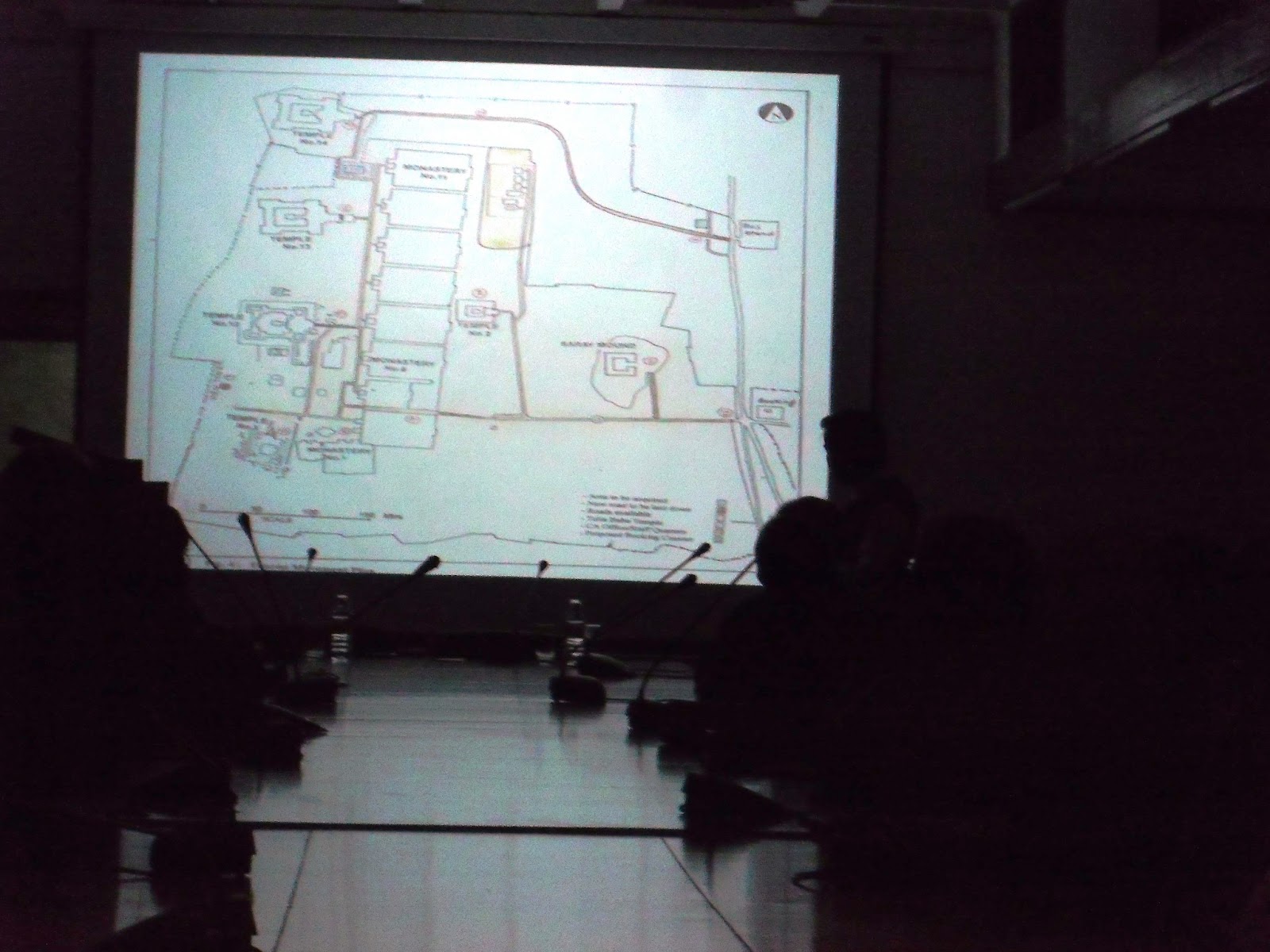
Site Map of the 1400 year old Nalanda University

Mr Muhammed (who headed the Patna Circle of the ASI) shared with us anecdotes (apparently the half buried Ashokan Pillar of ancient Vaishali was used by a farmer to tie his cattle), his personal experiences while dealing with government apathy (apparently the Indian Railways was insisting to build a railway line over a mound which later turned out contain a 1400 year old stupa, Mr Muhammad had to start excavating the site without legal permission to unearth the stupa and foil the Railways' archaeologically disastrous plan).

Mr Muhammed displays the progress of excavations over the Kesariya stupa, the highest in the world

 Observe a 150 years old pic (behind the speaker) of the mound which covered the ruins of Nalanda University

Mr Muhammed showed rare pictures taken by British archaeologists of the mounds which contained the ruins of the Nalanda University and really old pictures of mounds containing the stupa's of Kusinagar, Vikramshila University, Rajgir, Kesariya e.t.c.

 Portrait of famous Chinese traveler and monk Hsuan Tsang
Picture Source - Wikipedia

He also described the immense value Chinese traveler Hsuan Tsang's (above) (who visited India during the 7th century) journals had for Indian archaeologists and historians. Many significant stupas were located with the help of his journals as all other records were lost.

 Archaeologist Mr K. K. Muhammed

After this discourse it became clear to me that it would not be entirely fair to criticise the ASI for not conserving monuments as (in the words of Mr Muhammed) the government does not realise the fact that building 5 star hotels would not boost tourism.. Conserving monuments and archaeological treasures would..

Friday, February 1, 2013

Picture of the Week #16 - Bengali Street Food

Picture © Rohan A Singh