The 28th Delhi Book Fair 2024

A posts on the crowds, books and my experiences of The Delhi Book Fair 2024.

Remembering Professor Sunil Kumar

He was one of the greatest historians who worked on the history of medieval delhi, which served as capital of the Delhi Sultanate (1192-1526 CE) for 300 years.

Temple of the Emerald Buddha - Amazing Thailand

This series is based over my reflections upon visiting Thailand.

The Immortal Kumbh Mela - Mahakumbha of 2013

Believed to be the largest congregation of mankind in the world, read my series of posts to know how it feels like to be amongst a magnitude of people

Shahjahanabad (Const 1648 CE)- The Legacy of Delhi Series (Vol 8)

'Shahjahanabad' is the eighth post in a series of 9 articles on the former capital cities which were built in the historical region of Delhi. Read on to know more..

Follow

uencounter.me

Thursday, December 15, 2011

Lord Ayappa - Swamiye Sharanam Ayyappa

Often it happens that we plan a trip or an expedition in so much detail yet the result might not fulfill our expectations. But, sometimes it also happens that while we are just taking a casual walk we come across something stunning.. something that takes our breathe away. Even fewer are fortunate enough to carry a camera and take snaps of those beautiful moments.  On a Sunday evening I came across such a religious procession which was in honour of Lord Ayyappa. The procession was grand and pompous to say the least and the people were observing very old traditions while participating in it.

Row of Lamps leading to the Sanctum Sanctorum of Lord Ayyappa. Notice the floral patterns (rangoli) between the row of lamps

Lord Ayyappa or Ayyappan(Malayalam) is a Hindu deity worshiped in various shrines across India. Ayyappan is believed to be an incarnation of Dharma Sastha, who is the son of Lord Shiva and Lord Vishnu (as Mohini). The name "Ayyappan" is used as a respectful form of address in the Malayalam language, spoken in the Southern most Indian state of Kerala. The most famous Ayyappa shrine in India is the one at Sabarimala (Mt. Sabari - 3000 ft abve sea level), Kerala with over 30 million devotees visiting it every year, making it one of the largest pilgrimage sites in the world.

The procession on its way to the temple

The procession in honour of Lord Ayyappa which I had the privilege of witnessing was being held as this is the period of the year when pilgrimage to Sabarimala shrine is held. This pilgrimage will continue till mid January.
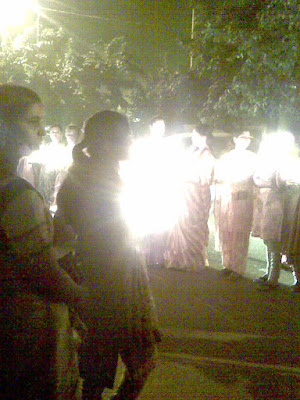
Row of women standing with lamp bearing thali's (dishes)

The procession which I observed began in the evening. There were two rows of women clad in white sarees in at the front. They held a puja (adoration/worship) thali (dish) in their palms upon which there was a diya (Lamp) which illuminated the entire way ahead. Behind them came a Chariot which had the image of Lord Ayappa. At the rear of the procession there was a large elephant atop which a priest sat with an image of Lord Ayappa which was installed in the temple where the procession ended.

Lord Ayyappa

Take a look at the following pictures to see what I meant about the procession being grand and pompous and the temple or pandal being even grander still. Even though the picture quality is not exactly the best but yet the magnificence of the procession is clearly visible !

The carriage in which the second idol of Lord Ayyappa was being taken


The elephant at the rear of the procession upon which the main idol was being carried by the priest

The puja thali with the lamp. Observe that the lamp is based in a coconut shell !


A banana shoot adorning the entrance

Musicians wearing traditional clothes played typical kerala-ite music during the entire procession

Fireworks were displayed when the lord's idol reached the temple at the end of the procession


Image of Lord Ayyappa

Elephant who carried the image of the Lord atop itself

Banana leaves atop the entrance of the temple

A large oil lamp

Observe the beautiful floral patterns or Rangolis

Another lamp with lotus petals and jasmine flowers in the middle of them and also marigold flowers by it's side

Observe the rangoli of depicting Goddess Mohini

Lord Ayyappa's centrality in a keralite's life is displayed in this tableau of Lord Ayappa atop an elephant at the Kerala pavilion of the India International Trade Fair 2011

Sand Sculpture of Lord Ayyappa
Source Wikipedia


Swamiye Sharanam Ayyappa
(O Ayyappa ! I seek refuge in you)


Monday, December 12, 2011

100 years of New Delhi - The Beginings of a Great City

 On this very day of December 12th - exactly 100 years back - in the year 1911 A.D. the Imperial Emperor George the Fifth of Great Britain came to Delhi along with his Queen Consort Mary, sat at his magnificent Delhi Durbar, announced his ascension to the throne of Great Britain, accepted homage's and promises of allegiance from the Indian rulers and then announced to the entire world the British intention of establishing a new capital of India and to call it 'New Delhi'. Thus, a new chapter began to be written in the long, grand and sometimes bloody history of Delhi.

The magnificent Delhi Durbar 1911. King George the Fifth declared at this Durbar that the capital of the British Raj would be shifted from Calcutta to Delhi
Source - Wikipedia

The Delhi Durbar was held amidst great pomp, splendour and excitement as the picture suggests; held in the middle of vast barren dusty plains of North Delhi. The selection of the place was not co-incidental as on the very grounds the Durbar's of Queen Victoria (1877) and King Edward the Seventh (1903) were held. Moreover, near this very spot, the British had won a crucial victory over the rampaging Indian armies taking part in the Sepoy Mutiny (Indian War of Independence) of 1857, so the place had special value for them. 

This obelisk was erected at the exact place where the King and the Queen sat in Durbar of 1911

The Britishers did not do anything unique by announcing to establish their new capital at New Delhi, they were simply continuing with the traditions of previous pan-India Hindu (Indraprastha), Islamic (Tughlaqabad) and Mughal (Shahjahanabad) rulers who had established their capitals over here.

The Commemoration Plaque under the Obelisk

Since that fateful day the city of New Delhi has come a long way. The British and (later) Indian capital of New Delhi was built by architects Sir Edward Lutyens and Sir Herbert Baker. The construction of the city began only after the First World War ended (1919) and was completed by 1931. The landmark buildings constructed by Lutyens in New Delhi were All India Memorial(India Gate), Viceroys House(Rashtrapati Bhawan), the Parliament, Central Secretariat, the Lutyens Bungalow Zone (which houses current M.P.s of India) e.t.c.

This postal stamp was issued by the Imperial Post Office over the inauguration of New Delhi on 1931 A.D.

Till date the portion of the city of Delhi which Sir Edward Lutyens constructed is called as Lutyens Delhi.

The statue of King George the Fifth. This statue was originally located right next to the India Gate from where it was removed in the 1960s and placed opposite the Obelisk at Commemoration Park.

Following are the pictures of 'Lutyens' Delhi' or the portion of the city which Sir Edward Lutyens completed in 1931. The names of the buildings in the British Era are given in brackets wherever required - 

India Gate or the All India Memorial (as called by the British) (at night). This memorial was constructed to honor the Indian soldiers who died fighting for the British Crown in the First World War (1914-1919)


Parliament of India

 Rashtrapati Bhawan (Viceroy's House)
Picture Source - Wikipedia

A view of Raj Path (King's Way). The way stretches from Rashtrapati Bhawan to India Gate. The parade on Republic Day(on 26th January) takes place over here.

Raisina Hill which hosts the Central Secretariat (North Block - Right, South Block - Left). Notice the Jaipur Column in front of the Central Dome. The Raj Path (Kings Way) starts from this point.

 This lamp post is a reminder of the colonial times. In the backdrop is the bell tower 
of the North Block of Central Secretariat.

A street in Lutyens Delhi. Streets in this portion of Delhi are known for their immaculate planning.

This week onwards I would on every Tuesday post a special article over Delhi which would cover city's history and the present. I would prefer to name the weekly series of articles as Delhi-teful Tuesdays. Happy Reading !

You can now join our Facebook Page for beforehand information and exclusive pictures.


Tuesday, December 6, 2011

A Country Fair in India - Experience of a Lifetime

A Fair or a Mela (as said in India) is a gathering of people to display or trade goods (New York Trade Fair) or to parade or sell animals (Pushkar Fair) or for religious purposes (Kumbh Mela) in a carnival or excitement filled atmosphere. The importance of Mela's or Fairs in India is immense. They are mostly held during festive seasons or annually.
From the Maha (Grand) Kumbh (Pot) Mela (A religious fair which attracts crowds of up to 60 million people and is held every 12 years), the Pushkar (Town in Rajasthan) Mela (Worlds largest annual camel fair) to the small country side mela's which attract large crowds.. There are many fairs, big and small, which take place and people do flock to them in large numbers.

So, what is it about these country side mela's which is so alluring ? Why despite the presence of malls and multiplexes do people still flock to them ? Where does their charm lie ? I will try to look for answers in this post ! Read on..

Mela's are vital to the lives of people in rural India, Pakistan, Nepal, Bangladesh e.t.c. and other countries as well (where they might be called as countryside fairs). They are mostly held during festive seasons or annually. In such fairs makeshift stalls like the ones in the pictures to follow sell toys, food e.t.c. and other stuff which attracts the attention of the children and grown ups alike! Folks from the cities or those who live in hardship throng to the fairs which offer them happiness and joy by spending time together with their families. The fairs sell inexpensive stuff but the joy it brings to the people who visit it is priceless. These are snaps which were taken of one such country fair before it started and got mobbed ! Ingredients of a country fair -

A Paper Wheel stall. Very light, it runs on exposure to the wind (It is a children's favorite)

Ganna or Sugarcane shoot stall

To consume it you need first chop the shoots to smaller sizes(the shopkeeper will help you do that) hold it with both your hands(like a flute) peel off the skin with your teeth(it takes some effort) and then munch the soft sweet juicy core. When the core becomes dry you can spit it out, anywhere. Yes ! 

The Bubble Blower Guy
When I see children run around him trying to grab the bubbles he blows out I instantly remember my childhood 

Stall selling sweetmeats. At the center are Jalebi's and on the left are Gujiya's
Observe the flat wok in which these sweets are deep fried

Stall selling snacks. Onion Pakora's (Served hot, crisp with salad) (on the left), Bread Pakora's (middle), Namakpara's (Salty snacks)(on the right)
Observe the cook in the background preparing Jalebi's.

The Jalebi counter

Stall selling dry munchies like Popcorn(on the Right), Peanuts (On the Left) and other sweet and fried munchies. Observe the clay fired wok on extreme right in which he prepares popcorn with rock salt.

Stall selling Kulfi's(dried whole milk based).
Observe the brass bell which the man rings to attract attention of the kids

Chuski or Ice Candy stall. A very good candy preparation to sip during Indian summers.
This preparation is basically crushed ice dipped in flavored syrup. You need to suck the ice cool flavored syrup from the crushed ice. The most popular flavor of chuski is Kaala- Khatta (Sweet n Sour)

Stall selling Swords, Maces, Bows {toy ones of course :-)} e.t.c.

The Chholey Bhaturey stall


..and last but not the least.. The effigy of Ravana around whom the entire fair was organised.
The occasion was Dussehra and the effigy of Ravana is burned at every Dussehra

You can now join our Facebook Page for beforehand information and exclusive pictures.

Wednesday, November 30, 2011

Magnificent Desolation of the Tibetan Plateau - Sikkim Sojourn Part 10

The Khangchenyao Ranges


When you are sitting in the SUV and move towards the heart of the Himalayas, you see the greenery gradually melt away, giving way to barren lands, barren hills where the air is cold, the air is thin. Gradually, you begin to realize yourself, you begin to realize your existence, and you realize that you are in the domain.. in the territory of Mother Nature. You understand that this is a place where you do not toy with the nature but the nature toys with you. While making every movement, while taking every breath you understand (to your delight) that this is a place which you cannot master, just respect.

 This vast expanse of nothingness stretches through the entire Tibet region

 Army outposts monitoring the border (Beyond these ridges you can see the international border with China)
 
When I moved through the valley where unpaved roads ran parallel to the heavily mined border with China you realize you are at the outermost edge of India. People have come and gone. Lines have been drawn and re drawn, but the image remains the same, it is immortal unlike us. The land keeps challenging us just as it challenged all of our ancestors.

 Snow capped crags(mountains) overlooked us on the other side of the valley

 
This land has seen many a people walk across its chest to visit the turquoise speck of water(Guru Dongmar Lake) across its brown horizon and it will continue to see people walk across it. It will continue to challenge everyone. If you win you can get a glimpse of serenity, harmony, and through it a glimpse into your inner soul.

These features obstructed our view of China and China's view of us, but we did not take the risk of climbing this hill (an easy task) because of the fear of landmines

 The ancient road which we took to our destination has existed since ages (Picture taken from inside the SUV)

The way to Cholamu Lake (Highest Lake in India)
  
Next stop Guru Dongmar Lake (Taken from inside the SUV)

You can now join our Facebook Page for beforehand information and exclusive pictures.