The 28th Delhi Book Fair 2024

A posts on the crowds, books and my experiences of The Delhi Book Fair 2024.

Remembering Professor Sunil Kumar

He was one of the greatest historians who worked on the history of medieval delhi, which served as capital of the Delhi Sultanate (1192-1526 CE) for 300 years.

Temple of the Emerald Buddha - Amazing Thailand

This series is based over my reflections upon visiting Thailand.

The Immortal Kumbh Mela - Mahakumbha of 2013

Believed to be the largest congregation of mankind in the world, read my series of posts to know how it feels like to be amongst a magnitude of people

Shahjahanabad (Const 1648 CE)- The Legacy of Delhi Series (Vol 8)

'Shahjahanabad' is the eighth post in a series of 9 articles on the former capital cities which were built in the historical region of Delhi. Read on to know more..

Follow

uencounter.me

Tuesday, June 19, 2012

Qutb Group of Monuments Part One

The Qutb Group of Monuments in Mehrauli, New Delhi, is a group of monuments constructed by various kings who ruled Delhi over a period of time. The Qutb Group of Monuments includes the Qutb Minar, Alai Darwaza, Iron Pillar, Alai Minar, Ruins of demolished Hindu and Jain Temples, Sultan Iltutmish's Tomb, Sultan Ala ud din Khalji's Tomb, Madarsa (Islamic Seminary) constructed by Ala ud din Khalji, Arch Ruin of Quwwat ul Islam Mosque, Smith's Folly, Sanderson's Sundial, Tomb of Imam Zamin. There are, of course, other monuments of equal historical and archaeological importance which surround the Qutb Group of Monuments and form a part of the Mehrauli Archaeological Park.

The Qutb Group of Monuments were built (as per timeline) by the Hindu Rajas (till 1192), the Mamluks Sultans (Qutb ud din Aibak 1206-10  and Shams ud din Iltutmish 1211-36), the Khalji Sultan Ala ud din (1296-1316), and the Tughluq Sultan Feroze Shah (1353-88). Each of the rulers mentioned above have left a deep imprint on the history of India as well as on this Complex.


Period of Hindu Rajas

The first rulers who constructed monuments (temples) in this area were the Tomars and Prithvi Raj Chauhan II, who got constructed 27 Hindu and Jain (Jainism) temples. The ruler Anangpal Tomar also got shifted, the iron pillar which was located originally at Udayagiri, in the 10th century, to its present location.
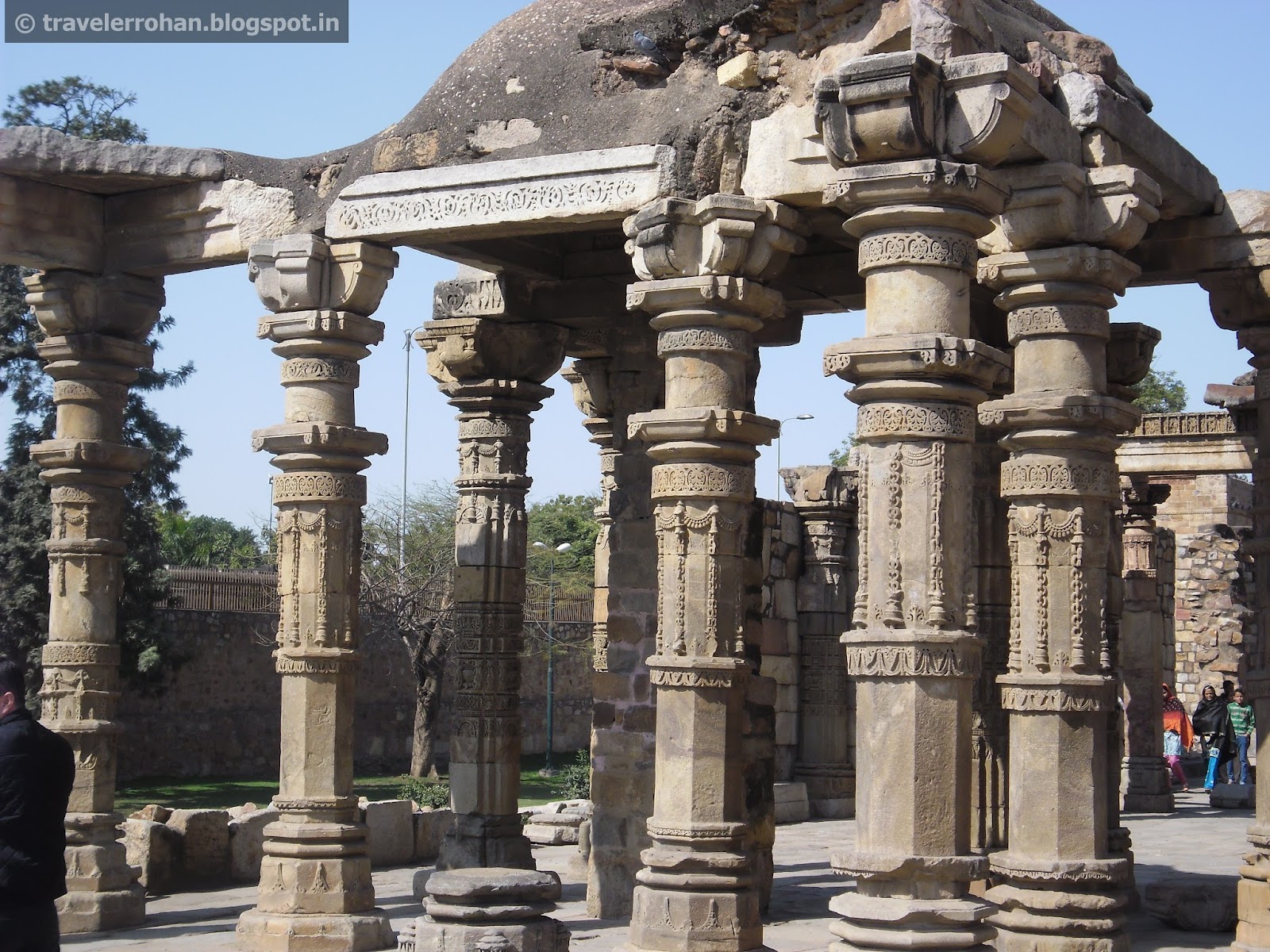
 Some of the remaining pillars of the destroyed Hindu and Jain temples. Observe the carvings of bells, chains e.t.c. over them.

 One of the more beautifully carved and still standing pillar.

Most of those temples were demolished by Qutb ud din Aibak who reused the materials for the construction of the Quwwat ul Islam Mosque and the Qutb Minar (as per a Persian inscription on the inner eastern gateway). Although some portions of the temples outside the mosque were left untouched, and they remain standing there till this date. Historical records compiled by Muslim historian Maulana Hakim Saiyyid Abdul Hai confirms the destruction of the temples by Qutb-ud-din Aibak.

 Observe the carving of a bell with chains hanging from a mythical creatures mouth

Some shafts of the temple columns, decorated with carved human figures covered in bracelets and cable and link chains terminating in bells or tassel rosettes, were left alone. On some of the overhead slabs, representations of Vishnu and Buddha along with lotus motifs are still visible.


One of the biggest wonders in the Qutb Group of Monuments, apart from the Qutb Minar, is the (over 1600 years old) Iron Pillar. This Iron Pillar is 7.21 m (23 ft) high and 14,354pounds (6511 kgs) in weight. It is located right in front of the arch ruin of Quwwat ul Islam mosque and is notable for the composition of the metals used in its construction.

 The Iron Pillar

 Arch Ruin of the Quwwat ul Islam Mosque and the Iron Pillar standing next to each other

The pillar, is said to have been fashioned at the time of Chandragupta Vikramaditya (375–413) of the Gupta Empire. The pillar was originally erected in front of a Lord Vishnu Temple complex at Udayagiri around 402 AD, and later shifted by Raja Anangpal Tomar in 10th Century AD from Udayagiri to its present location. Raja Anangpal built a Vishnu Temple here and wanted this pillar to be a part of that temple.


 Inscriptions over the Iron Pillar


The pillar has attracted the attention of archaeologists and metallurgists and has been called "a testament to the skill of ancient Indian blacksmiths" because of its high resistance to corrosion, due to both the Delhi environment providing alternate wetting and drying conditions, and iron with high phosphorus content conferring protection by the formation of an even layer of crystalline iron hydrogen phosphate.


Period of Mamluk Sultans (Qutb ud din Aibak and Iltutmish)
   
Qutb ud din Aibak was a general in the army and a slave of Mohammad Ghori. So when Mohammad Ghori (after his invasion of India) went back to Afghanistan he left him (after making him Naib us Sultan) in charge of his territories in India. Iltutmish too was a slave (later a son in law) of Qutb ud din Aibak. So this is where the term 'Mamluk' (or a soldier of Slave origin) gets attached to these rulers and their dynasty.

They were the first Islamic rulers to govern India. They did so effectively and efficiently in matters of defence and administration. These rulers also constructed quite a few monuments amongst which the most iconic is the Qutb Minar.

Qutb Minar

The other monument of reputation built by them is the Quwwat-ul-Islam mosque (Might of Islam) (also known as the Qutb Mosque or the Great Mosque of Delhi). It was the first mosque built in Delhi after the Islamic conquest of India and the oldest surviving example of Ghurid architecture in Indian subcontinent.

Entrance to the Quwwat ul Islam Mosque

The construction of this Jami Masjid (Friday Mosque), started in the year 1193 AD. The Qutb Minar was built simultaneously with the mosque but is a stand alone structure, built as the 'Minar of Jami Masjid', for the muezzin to perform Azan (call for prayer) and also as a 'Qutb - an Axis or Pole of Islam'.

Side View of the mosque

The mosque is built on a raised and paved courtyard, measuring 141 ft (43 m) by 105 ft (32 m), surrounded by pillared cloisters added by Iltutmish between 1210 and 1220 AD. The stone screen between prayer hall and the courtyard, standing 16 mt at its highest was added in 1196 AD, the corbelled arches had Arabic inscriptions and motifs.

By the time of Iltutmish, the Mamluk empire had stabilized enough that the Sultan could replace most of his conscripted Hindu masons with Muslims which explained why the arches added under Iltutmish are stylistically more Islamic than the ones erected under Qutb ud din's rule, also because the material used wasn't from demolished temples.

Inscriptions above the entrance of Quwwat ul Islam Mosque

The beautiful interiors of the dome of the mosque (the materials used here were taken from the demolished Hindu temples)

The mosque is in ruins today but indigenous corbelled arches, floral motifs, and geometric patterns can be seen among the Islamic architectural structures.


Another structure of importance in the Qutb Complex built during the Mamluk Period was the Tomb of Emperor Iltutmish, (1211-1236 AD).

The Tomb of Iltutmish. The prayer niche (Mihrab) is visible behind the grave.

The central chamber of the tomb is 9 sq. mt and has squinches, suggesting the existence of a dome, which has since collapsed. The main cenotaph, in white marble, is placed on a raised platform in the centre of the chamber. The facade is known for its ornate carving, both at the entrance and the interior walls. The interior west wall has a prayer niche (Mihrab) decorated with marble, and a rich amalgamation of Hindu motives into Islamic architecture, such as bell-and-chain, tassel, lotus, diamond emblems.

The No-Nonsense Travel Advice
Name of the Monument
Qutb Complex
Constructed By
Emperors Qutb ud din Aibak, Iltutmish and Others
Period of Construction
12th, 13th and 16th centuries. Repair works carried out during 14th, 16th and 19th centuries.
Location
Mehrauli, New Delhi
How to Reach
(By Metro) Get down at Qutub Minar Metro Station (on the Yellow Line) and walk the short distance OR take an Auto Rickshaw from your Starting Point OR take a Hop-On-Hop-Off sightseeing bus which is run by Delhi Tourism. Fare is Rs 300 for Adults and Rs 150 for children. Checkout Delhi Tourism website for details.
Entrance Fee
. Citizens of India and visitors from Bangladesh, Nepal, Bhutan, Sri Lanka, Pakistan, Maldives, Afghanistan, Thailand and Myanmar - Rs. 10 per head
. Visitors from other countries -
Indian Rs. 250/- per head
. (Free entry to children up to 15 years)
Suggested Reading

(To be continued.......)
.......

(Starting from the previous week's edition of Delhi-iteful Tuesdays you would be presented a fresh and acutely informative series christened Destination Delhi. This series would cover the beautiful and historical city of Delhi in detail and present you every 'landmark' worth visiting. So, Discover and Enjoy..)

Tuesday, June 5, 2012

Qutb Minar


Qutb Minar (pronounced Qoot-ub Minar), a UNESCO World Heritage Site is located in Delhi, India. The Qutb Minar, constructed with red sandstone, marble, lime mortar and rubble masonry, is the tallest brick minaret in the world, with a height of 72.5 metres (237.8 ft). It contains 379 stairs to reach the top, and the diameter of the base is 14.32 m while it is about 2.75 m on the top. It is surrounded by several other ancient and medieval structures and ruins, collectively known as the Qutb complex.


Their are many reasons cited for the construction of the Minar. The most commonly accepted  reasons are that In order to celebrate the advent of Muslim dominance in Delhi (and India), the first ruler of the Delhi sultanate, Qutb-ud-din Aibak, inspired by the Minaret of Jam in Afghanistan and wishing to surpass it,  commenced construction of the Qutb Minar in 1199 A.D. Qutb ud din Aibak also wanted it for the use of the mu'azzin (crier) to give calls for prayer (in the city of Qila Rai Pithora). The minar was completed by his successor Shamsu'd-Din Iltutmish.

The Entrance into the Minar


A snapshot of the Kufic inscriptions on the first floor of the Minar.  This floor was constructed while the first Slave (Mamluk) King Qutbuddin Aibak was alive and majority of these inscriptions praise Mohammed Ghori (Qutbuddin's master)

The Minar, made with numerous superimposed flanged and cylindrical shafts in the interior, and fluted columns on the exterior, which have a 40 cm thick veneer of red and buff coloured sandstone; all surrounded by bands of intricate carving in Kufic style of Islamic calligraphy, give the Minar the appearance of 'bundled reeds' from a distance. Also marking a progression in era, is the appearance of inscriptions in a bold and cursive Thuluth script of calligraphy on the Qutb Minar, distinguished by strokes that thicken on the top, as compared to Kufic in earlier part of the construction.

View of the honey comb like designs under the balcony of the First Floor of the Minar. The Minar represents an excellent example of Indo-Islamic architecture

The Qutb Minar and the Quwwat ul Islam Mosque are built on the ruins of 27 (demolished) Hindu and Jain temples, which were built by the Tomars and the Chauhans, who were amongst the last Hindu rulers of Delhi.


Many historians believe that the Qutb Minar was named after the first Slave King Qutb-ud-din Aibak, but others contend that it was named in honour of the Sufi Saint Qutb-ud-din Bakhtiyar Kaki, from the Middle East who came to live in India and was greatly venerated by Sultan Iltutmish.

Observe the distinct top two floors (covered with marble) of the Minar which were constructed by Emperor Feroze Shah Tughlaq

As the Qutb Minar was a tower of immense height quite a few times it got struck by lightning and so, had to be repaired time and again. According to the inscriptions on its surface the Minar was repaired restored by Emperor Feroze Shah Tughlaq (AD 1351-88), Emperor Sikandar Lodi (AD 1489-1517) and Major R.Smith in 1829.

The Iron Pillar and the Qutb Minar

The nearby Iron Pillar is one of the world's foremost metallurgical curiosities, standing in the famous Qutb complex. Tradition assigns the erection of the Pillar to Anang Pal Tomar, whose name it bears, with the date 1052 C.E. According to the traditional belief, anyone who can encircle the entire column with their arms, with their back towards the pillar, can have their wish granted. Because of the corrosive qualities of sweat the government has built a fence around it for safety. The quality of Iron used in the pillar is an excellence of technology. The smoothness of the pillar surface makes it rust proof. The amalgamation of different metals with Iron produces such high quality of smoothness.


The minar as seen from the ruins of the Quwwat ul Islam Mosque. Observe the tilt of the minaret towards the right.

The Qutb Minar has a tilt of 25 inches to the southwest. This is considered to be "within safe limits", but experts have stated that the monument needs regular monitoring in case rainwater seepage further weakens the foundation.


The No-Nonsense Travel Advice
Name of the Monument
Qutb Minar
Constructed By
Emperors Qutb ud din Aibak and Iltutmish
Year of Construction
1199 A.D.
Location
Mehrauli, New Delhi
How to Reach
(By Metro) Get down at Qutub Minar Metro Station (on the Yellow Line) and walk the short distance OR take an Auto Rickshaw from your Starting Point OR take a Hop-On-Hop-Off sightseeing bus which is run by Delhi Tourism. Fare is Rs 300 for Adults and Rs 150 for children. Checkout Delhi Tourism website for details.
Entrance Fee
. Citizens of India and visitors from Bangladesh, Nepal, Bhutan, Sri Lanka, Pakistan, Maldives, Afghanistan, Thailand and Myanmar - Rs. 10 per head
. Visitors from other countries -
Indian Rs. 250/- per head
. (Free entry to children up to 15 years)
Suggested Reading
.......
(From this bi-weekly edition of Delhi-iteful Tuesdays you would be presented a fresh and acutely informative series christened as Destination Delhi. This series would cover the beautiful and historical city of Delhi in detail and present you every 'landmark' worth visiting. So, Discover and Enjoy..)

Tuesday, May 22, 2012

New Delhi (1929 A.D.) - The Legacy of Delhi Vol 9

(In this edition of Delhi-iteful Tuesdays I am bringing to you the ninth edition of this historical series The Legacy of Delhi.) 

Calcutta (Kolkata) was the capital of India until December 1911 during the British Raj. However, Delhi had served as the political and financial center of several empires of ancient and Delhi Sultanate, most notably of the Mughal Empire from 1649 to 1857. During the early 1900s, a proposal was made to the British administration to shift the capital of the British Indian Empire (as it was officially called) from Calcutta to Delhi. Unlike Calcutta, which was located on the eastern coast of India, Delhi was located in northern India and the Government of British India felt that it would be easier to administer India from Delhi rather than from Calcutta.                                                                               
India Gate or the All India Memorial (as called by the British) (at night). This memorial was constructed to honor the Indian soldiers who died fighting for the British Crown in the First World War (1914-1919)

Connaught Place at Night. It was developed as a showpiece of New Delhi (planned by Edward Lutyens) featuring a Central Business District.

Night View of the inner radial of Connaught Place


History -
                  As per a letter sent by Lord Hardinge (the then viceroy of India) to the Earl of Crewe in 1911 the britishers wanted to move out of Calcutta to Delhi because of the rising importance of legislative bodies meant that Britain needed to find a more centrally located capital.  There was also an increasing resistance to the British rule in Calcutta that was making it less than a hospitable capital city. The people's movement for Home-Rule was growing stronger and after Lord Curzon partitioned the Bengal in 1905  into two along religious lines (in an attempt to quell the movement) the nationalist sentiments of the Indians had grown manifold as well which eventually led to large protests, boycott of British goods and a spate of political assassinations. 
                
 Aerial View of the Rashtrapati Bhawan (Presidential Palace) (Architect - Sir Edward Lutyens)

 Parliament of India (Architect - Sir Herbert Baker)

On December 12th 1911, a magnificient Delhi Durbar of (British) Imperial Emperor George the Fifth was organnised to announce his ascension to the throne of Britain. He accepted homage's and promises of allegiance from the local Indian rulers (vassals) and then announced his intention of building a new capital city would be made in Delhi for the British India. Moreover the British Emperor George the fifth, was simply continuing with the traditions of previous pan-India Hindu (Indraprastha), Islamic (Tughlaqabad) and Mughal (Shahjahanabad) rulers who had established their capitals over here.
                                                                                      
Architecture -
                               Much of New Delhi, planned by the leading 20th century British architects Edwin Lutyens and Sir Herbert Baker, was laid out to be the central administrative area of the city as a testament to Britain's imperial vanity. The construction of the city began after the First World War ended (1919) and was completed by 1931.

 A view of Raj Path (King's Way). The way stretches from Rashtrapati Bhawan to India Gate. The parade on Republic Day(on 26th January) takes place over here.

  Raisina Hill which hosts the Central Secretariat (North Block - Right, South Block - Left). Notice the Jaipur Column in front of the Central Dome. The Raj Path (Kings Way) starts from this point. This spot is also known as Vijay Chowk (Victory Square).

                              While planning and constructing New Delhi Edward Lutyens invented his own new style of classical architecture, which is normally known as the "Delhi Order". Unlike the more traditional British architects who came before him, he was both inspired by and incorporated various features from the local and traditional Indian Indian architecture. For example -  although the dome of the Rashtrapati Bhawan (Presidential Palace) is said to have been influenced by the Roman 'Pantheon', it indicates an influence of the famous Sanchi Stupa (Buddhist architecture).
                            The landmark buildings constructed by Lutyens in New Delhi were All India Memorial (India Gate), Viceroys House(Rashtrapati Bhawan), the Parliament(designed by Sir Herbert Baker), Central Secretariat, the Lutyens Bungalow Zone (which houses current M.P.s of India) e.t.c.


Life in New Delhi -
                                           Today the city of New Delhi has already celebrated 100 years of being a formal capital to India . The city still serves as the capital and the seat of power for the Republic of India. It has expanded and incorporated all the former cities which ever stood in its vicinity into its modern borders. People from all parts of India come to Delhi in search for work and a better life. Various studies and travel magazines have dubbed New Delhi as 'Alpha-City', 'Metropolitan City', 'Cosmopolitan City', 'Most Expensive city for Expatriates in South Asia', 'A Must visit destination in your lifetime' e.t.c. e.t.c.

 A street in Lutyens Delhi. Streets in this portion of Delhi are known for their immaculate planning.


Culmination of the Series -
                                                             While I was doing considerable research for this series, visiting all the monuments and ruins of past, and then writing about them.. I started to understand how it felt like being a citizen of each of the preceding cities of New Delhi and I could not help but compare those cities with the city of today.
                                                             As compared to the past the city is much secure thanks to the stability provided by the Britishers and the current Indian establishment. Also as compared to the past the current government of India is much more stable than the previous governments because of its democratic nature.
                                                             I realized that this piece of earth has seen everything that could be seen. From the grand processions of Emperor Shah Jahan(1650 A.D.) to the massacre of its citizens ordered by Timur lane(1398 A.D.) and Nadir Shah (1739 A.D.). From seeing moments of dominance( when Ala ud din Khilji hung heads of Mongol Soldiers from the walls of Siri in 1299 A.D.) to moments of weakness (when the Britishers sacked the city of Shahjahanabad in 1857 A.D.)
                                                            Here's to hoping that after seeing instability for over a thousand years the city of Delhi now gets to see peace and stability for the next thousand years to come. Amen. 

The No-Nonsense Travel Advice
Name of the City
New Delhi, India
Architect
Edward Lutyens (of Lutyens Delhi)
Year of Completion
1931 A.D.
How to Reach Delhi
By Air – All major airlines fly in and out of Delhi’s Indira Gandhi Intl Airport
By Railways – The city is connected to all parts of India with regular trains
By Road – Interstate buses to all destinations in North India ply to and from Delhi
Places to Visit
Red Fort, Humayun’s Tomb, Qutb Complex (all World Heritage Sites), Connaught Place, Purana Qila (Old Fort), Akshardham Temple, Lotus Temple, National Museum, India Gate e.t.c.
Best Mode of Local Transport
. Take the Hop-On-Hop-Off Sightseeing Bus run by Delhi Tourism to cover Delhi in a day.
. If you wish to cover Delhi at your own pace then for budget travelers the best option is the Delhi Metro Rail. Take a Pre Paid Smart Card and travel around the City with ease

**

You can now join our Facebook Page (by clicking on the link) for more travel information and exclusive pictures.